It seems to many southern Arizona residents that the phrase “for the greater good” applies when government entities require a tax hike, but not when a private entity wants to generate taxes. Such was the case in the recent proposed relocation of a fast-food restaurant.
In a letter that has gone “Tucson viral,” dated April 21, 2015, Cortland Chalfant wrote the Tucson Mayor and City Council regarding zoning case #C9-14-10. Chalfant writes:
After 20-years of loyal commitment to Tucson’s economic development, charitable and social causes, I moved to Austin, Texas in December. I made that move not because I wanted to but, rather because it has become too difficult to make a living in Tucson. Too few opportunities, too much opposition and too little leadership.
Unfortunately, my experience with this case – a downzoning case that you know mitigated every conceivable concern of the handful of vocal opponents – is now an irreversible stain on the credibility of the development services department, the zoning examiner and the City of Tucson. It seems that my decision to move to Austin was the right decision to make.
Regrettably, I must respectfully join in the withdrawal of the above-referenced zoning application. Late this afternoon, after 778 days of work and over $250,000 spent, McDonalds Corporation gave notice that they have terminated their ground lease with my company for the building of a new McDonalds.
They withdrew because of the conflicting opinions of City staff and a small cadre of neighborhood opposition that spoke louder than the 110 individuals, businesses, civic leaders and nearby residents who wrote letters and made many personal appeals to you for support.
The single biggest reason for McDonald’s withdrawal is the inexplicable and unprecedented last minute reversal by your planning department of their recommendation to approve our plan and the lack of transparency and good faith in which the reversal was done. Apparently, the voices of a handful of neighborhood activists matter but the city’s documented planning policies and the overwhelming voices of support does not. Read letter here.
In response to the damning indictment, Arizona Daily Star columnist, Tim Steller leapt to the defense of the City “leaders” in a piece entitled A rejected McDonald’s doesn’t spell Tucson’s doom.
In his piece, Steller poses the question whether “we moving beyond strident NIMBYism into an era more open to economic activity?” After reciting some shallow “facts,” he concludes: “Tucson is learning to resolve neighborhood conflicts, those ritualized disputes in which somebody proposes a development, and neighbors or historic preservationists rise up to kill it…. the city’s decision on the McDonald’s is defensible and doesn’t spell doom in a city where good projects are getting done — eventually.”
In fairness, a review of the facts is necessary. As Steller notes, “Chalfandt held the ground lease for the property where McDonald’s was planning to build.”
“The corner is home to a boarded-up Shell station. A key argument for the new McDonald’s was that it would replace that blight,” according to Steller.
Steller points out the fact that the residents of the Julia Keen neighborhood “opposed the plan because they feared the McDonald’s, once closed, would become a blighted property.”
“McDonald’s planned to buy a house on East Camino de Palmas, the residential street one block north of East 22nd Street, to make room for parking. That was the main reason for the rezoning request that gave neighbors leverage. In short, those living nearby didn’t want a McDonald’s bordering their property, even with concessions the company made such as a decorative 8-foot wall and landscaping,” writes Steller in complete contradiction to his conclusion that “Tucson is learning to resolve neighborhood conflicts, those ritualized disputes in which somebody proposes a development, and neighbors or historic preservationists rise up to kill it.”
The opposition was led by the Darko family, according to Steller. They owned the house that would have been next door to the McDonald’s wall encased parking lot.” He quotes Tim Darko, “What about the $60,000 in value my parents’ home would lose? Everyone’s house would depreciate immediately.”
$60,000? According to the public record, Darko’s parent’s house was valued at $162,798 in 2008. Its current is $131,068. In seven years, it has lost nearly 20 percent of its value.
The house next door to Darko that would have been razed to make room for the extended parking lot was valued at $196,055 in 2008. Its current is $156,094. In seven years, it has lost slightly over 20 percent of its value.
Directly across the street from the Darko house, sits an abandoned home with boarded up windows. There is no telling what that property, in its current condition has done to property values. It is difficult to imagine how a McDonalds blocked by a wall would be more detrimental that the properties in decay that are in plain sight.
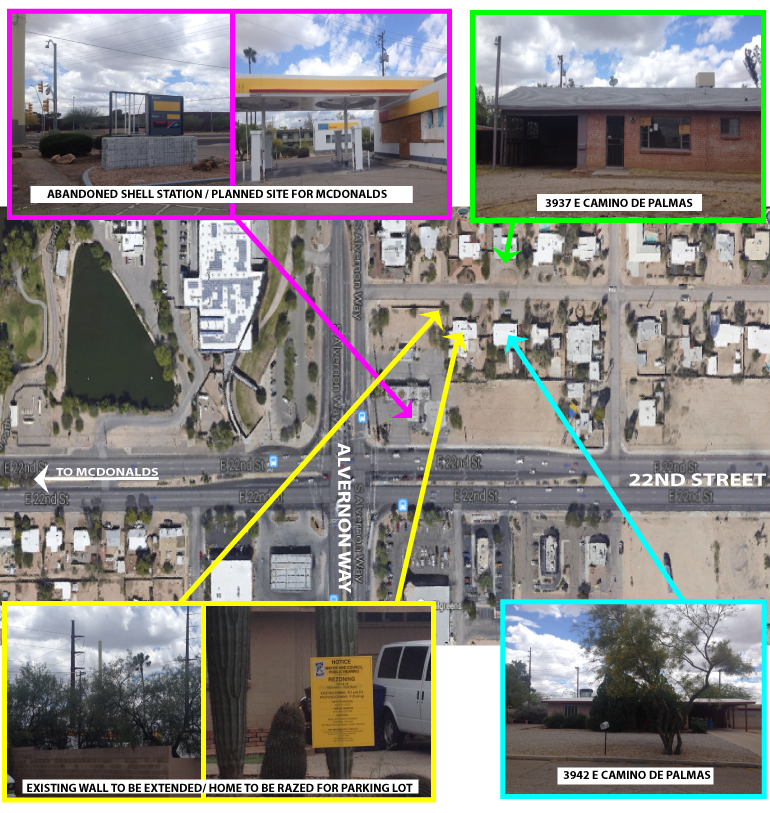
Still, as Steller writes, “the key point is that McDonald’s put itself in a position of needing rezoning, and therefore neighborhood support, by trying to re-zone residential property.”
In other words, McDonald’s never really stood a chance.
Despite the fact that city planners recommended approving the rezoning, the city staff recommended against the rezoning after the zoning examiner held a hearing and neighbors complained.
$250,000 gone due to the “inexplicable and unprecedented last-minute reversal by your planning department,” Chalfant wrote the Mayor and Council.
The neighborhood is in Councilman Steve Kozachik’s ward. He told Steller, “This isn’t Tesla, This is McDonald’s moving from one location to another.”
No truer words were ever spoken; Tesla didn’t move to Tucson. But in the City’s defense, a new grocery store might be built after the owner “gave up two building pads and agreed to give the local neighborhood association $10,000 to help it win historic designation,” according to Steller.
Steller says that even “notoriously neighborhood-oriented council member Karin Uhlich insists the city gets it.”
Uhlich, who lives in a property she bought outside of her ward, but rents an apartment in her ward so that she can stay in power, told Steller, “The fundamental question we have to ask, especially after such a horrible downturn in the economy, is ‘If not this, then what?’”
Residents are asking the same question.
Chalfant seems to have found an answer: “It seems that my decision to move to Austin was the right decision to make.”