To disheveled 16-year-old Agnes “Apple” Bailey, eating means just shoving food into her mouth, and sometimes she might have to get that food out of a dumpster. She doesn’t have the table manners or home address of her little half-brother and half-sister, whose meals are served at a fine table in a New Jersey mansion.
Apple apparently got her nickname when her father wrote her in a letter that she was the apple of his eye. But it was the only letter he wrote her. Apple’s life has been more like the punishment that cast-out Eve suffered after eating the apple in the Garden of Eden.
At one point Apple asks, “Where has God been in the years I’ve suffered?”
It’s not as if Apple did something to deserve this fate.
Now a bigwig New York broker, her father in his own teen years had gotten Apple’s mother pregnant, then he went on in life to business success and marriage with a different woman. Apple’s mother, meanwhile, descended into the gutters of drug abuse and male exploiters.
Like a pinwheel, Apple later is told by a priest when she’s hospitalized after crashing a stolen vehicle, “whenever the weather changes, you have no idea what way your life can go.”
Is this fairness for Apple? Is it merely chance that a little girl grows up with a desperate mother instead of a millionaire father?
When some people reach out to Apple, she finally is able to turn her life around. Unable to trust, she learns to do so. One can only hope that her biological mother, June Bailey, grasps that opportunity somewhere, too.
Although we’re not shown what finally becomes of the desperate June, her lamentation speaks for many: “You don’t know what I wanted out of life. You don’t know who I was, who I could’ve been.”
Apple’s story is told in the upcoming movie “Gimme Shelter,” opening Jan. 24 in limited release at 375 theaters (a Ronald Krauss film from Roadside Attractions and Day 28 Films; 100 minutes).
Chris Faddis, a consultant with Carmel Communications, an agency promoting the film, told a preview audience in Phoenix on January 7 that Apple’s story is a composite of several real young women’s experiences whose lives were transformed by crisis-pregnancy shelters.
“The story is as real as it can be,” Faddis said. “…This is not a movie, this is a movement.”
After she runs away from her mother, Apple traces her father to the New Jersey mansion. By the time she was 12, the miserable teen-ager says, she’d been in 10 foster homes.
With this surprise arrival on their doorstep, Apple’s father, Tom Fitzpatrick, and his wife, Joanna, agree rather uncomfortably that she can live with them and their two kids. But Joanna, suspicious of Apple’s nausea, asks if she’s pregnant. “We are not having this baby in our house,” Joanna insists.
With the precision of a man who makes his life by the mathematics of the market, Tom tells Apple that she should just press the delete button on this bad page in her life. He’s not trying to be cruel. There’s an easy answer. He’s just a man who doesn’t like messes.
“It’s clear you are not ready to assume the responsibility of motherhood,” he says, very responsibly. “…It’s time that you turn the page on this… And before you know it, you’ll have forgotten it ever happened.”
His wife warns Apple, “If you don’t cooperate, we’ll have no choice but to ask you to leave.” They give Apple no choice, either.
Joanna promises to hold Apple’s hand at the abortion clinic where they’ve made an appointment for her, but when the wife steps out of the room to wait in the clinic lobby, Apple, preferring to protect her preborn baby, goes on the run again.
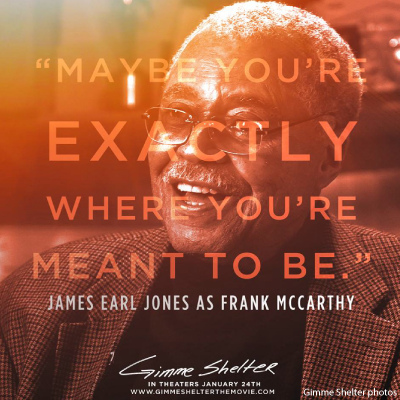
Ending up in the hospital after crashing an SUV, Apple is told by the Catholic chaplain there that he has found a shelter for her. Justifiably suspicious of life in shelters, Apple thinks the priest should stick to working in churches. Fr. Frank McCarthy replies, “This is my church.”
The director of this different sort of shelter, which specifically helps young pregnant women, insists on people taking responsibility, just as Apple’s father had. If they ended up in this shelter because of bad choices, they can’t turn themselves around if they don’t get hold of their lives.
However, their babies are part of their lives now, the kindly but firm director asserts. “Here you become a mother, and that means you take responsibility.”
An important component of taking control of life at this home is developing spiritually. That doesn’t mean everyone wears haloes or sings hymns to one another. But they get an interior support for themselves that could have been lacking. And, presumably, wouldn’t be provided by an impersonal agency that’s hostile to a prayer life.
Apple finally learns trust and fulfilled love with the multiracial young mothers and babies she lives with. Now she’s taking her own kind of baby steps, with her own beloved newborn baby girl in her arms. Apple becomes a beautiful, confident young woman.
That’s the reason this shelter exists, to prepare young women for a new chapter in life, not to close the book on a baby’s very existence.
Back at home, Tom and Joanna have taken some baby steps of their own. It’s fine for Apple to live at their mansion with her baby after all. They’ve even prepared a beautiful nursery for the little one.
And it turns out that Apple has finished running away. As her father starts to drive her to the elegant residence, Apple tells a surprised but understanding Tom that she needs time for this transition.
She goes back to the embrace of her overjoyed friends at the pregnant women’s sometimes disorderly, cluttered shelter.
One aim of the film is to make people aware of the shelters around the nation that care for displaced pregnant woman and their babies. Krauss wrote this screenplay after doing research by living at one of them, a Several Sources shelter in New Jersey.
People may search online for birth-affirming pregnancy shelters. “Maggie’s Place” is a well-known facility in the Phoenix area, 602 262-5555.
Faddis, the consultant who spoke to the preview audience at the Phoenix theater on Jan. 7, said the list of theaters screening this film should be posted in about a week at the movie’s Web site, gimmeshelterthemovie.com.
As for leading roles, Vanessa Hudgens plays Apple, James Earl Jones is Fr. McCarthy, Brendan Fraser is Tom, Rosario Dawson is June, and Stephanie Szostak is Joanna.