Every year the organizers of the Tucson and Gem and Mineral Show pick a mineral or a group of minerals it will showcase. Diamond is one of the minerals that has been chosen to be highlighted at this year’s event.
When you think of diamonds, you rarely associate them as being located in Arizona, the copper state. However, diamonds do occur in Arizona, where they are found at Meteor Crater, located about 18 miles west of the town of Winslow. This site is typically more often associated with a meteor impact than it is diamonds.
Natural diamonds are composed of the element carbon, which has been exposed to high pressures (45,000 to 60,000 times atmospheric air pressure), but relatively low temperatures (1,650 to 2,370 degrees Fahrenheit). These conditions occur in two places on Earth; in the uppermost mantle beneath relatively stable continental crust and at the site of a meteor impact.
Most natural diamonds are associated with small pipe-like intrusive bodies known as kimberlite pipes, which extend from the surface downward to the upper mantle. The magma contained within these pipes was formed at depths of 87 to 118 miles. However, diamonds are not contained within this magma. The magma acted as an elevator that transported diamond-bearing rocks that were formed in the mantle up to the surface.
Diamonds are located in both primary kimberlite deposits and secondary placer deposits. The placer deposits are located along streams and shorelines, where they occur in sedimentary rocks that are derived from the erosion of the primary deposits. Major kimberlite-bearing provinces are located in central and southern Africa, Canada, India, Russia, Brazil and Australia. Rich diamond-bearing marine placer deposits are located along the western coast of Namibia and South Africa.

More than a century ago, small sand-sized, black diamonds were discovered in the area of the Meteor Crater in northern Arizona. Associated with the iron-nickel meteorite, known as the Canyon Diablo Meteorite, these diamonds were formed, when graphitic impurities within the meteorite were instantly transformed into diamond by the heat and pressures resulting from the shock of the impact, when it struck the earth approximately 49,000 years ago.
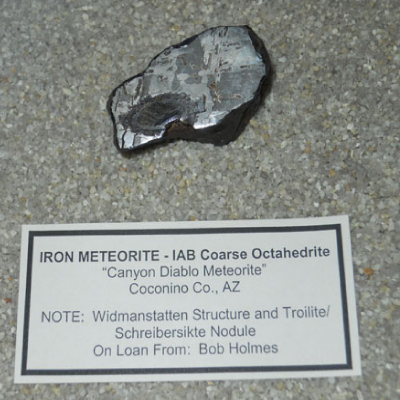
At that time, a meteor, measuring approximately 100 feet across and traveling around 30,000-mph struck the earth with a energy of 20 to 40 megatons, instantly vaporizing much of the meteorite. Remnants of the meteorite that struck this site are preserved as small fragments scattered within and around the resulting crater that measures 3,900 feet in diameter and approximately 570 feet deep. The crater rim rises 100 to 200 feet above the surrounding plain.
It is interesting to note that the arrangement of carbon atoms within the crystalline structure of diamonds that are found in kimberlite pipes and placer deposits differ from those found in meteorites. With extremely rare exceptions (Fuxian Kimberlite field in Manchuria, China), the crystalline structure of all terrestrial diamonds is cubic. However, diamonds formed by meteor impacts commonly exhibit both cubic and hexagonal crystalline structures. First identified in nature at Meteor Crater in 1967, the hexagonal variant of diamond is known as lonsdaleite, which retains the original crystal lattice structure of graphite.
Acknowledgement: The Tucson Gem and Mineral Show is a Trademark held by the Tucson Gem and Mineral Society, Inc.
Copyright (2014) by David F. Briggs. Reprint is permitted only if the credit of authorship is provided and linked back to the source.