Responding to pressure from the chambers of commerce Governor Ducey today announced a spending scheme that would inject $1.8 billion into K-12 schools over five years.
In 2010, then-State Treasurer Ducey pushed Prop 118, a measure that simplified how schools receive funds from the state’s land trust in order to ensure more consistent, reliable funding to K-12 schools.
The percentage that was set for distribution was 2.5 percent each year, with 93 percent of that money going to K-12 education.
Governor Ducey’s new proposal would increase the current distribution formula from 2.5 percent to 10 percent for a period of five years. If approved, the governor’s plan would give schools about $1.8 billion more than they would receive under the current formula in the first five years. After that, the formula would shift to 5 percent for the following five years — double the current rate.
Governor Ducey hastily called a press conference to ask the Legislature to take up this proposal and refer it to the ballot for voters to approve. Many are asking why he did not make the move during this last Legislative session.
The Governor’s Plan:
- Increases the current distribution formula from 2.5 percent to 10 percent over five years, and shifts to a rate of 5 percent for the following five years — still double the current rate;
- Gives schools nearly $1.8 billion more than they would currently receive from the formula over five years;
- Accomplishes all of this with no new taxes and no additional general fund spending.
While the plan will increase funding to the schools there doesn’t appear to be any provision to insure that the funding gets into the classrooms which seems to be a major problem in Arizona K-12 education.
Legislative leadership and Superintendent of Public Instruction Diane Douglas were noticeably absent from what many viewed as a publicity stunt. He was surrounded mostly by members of the chambers of commerce.
Ducey is reacting to a report by the U.S. Census Bureau on per pupil spending. The report, Public Education Finances: 2013, provides figures on revenues, expenditures, debt and assets (cash and security holdings) for the nation’s elementary and secondary public school systems. The report and tables, released annually, include detailed statistics on spending — such as instruction, student transportation, salaries and employee benefits — at the national, state and school district levels.
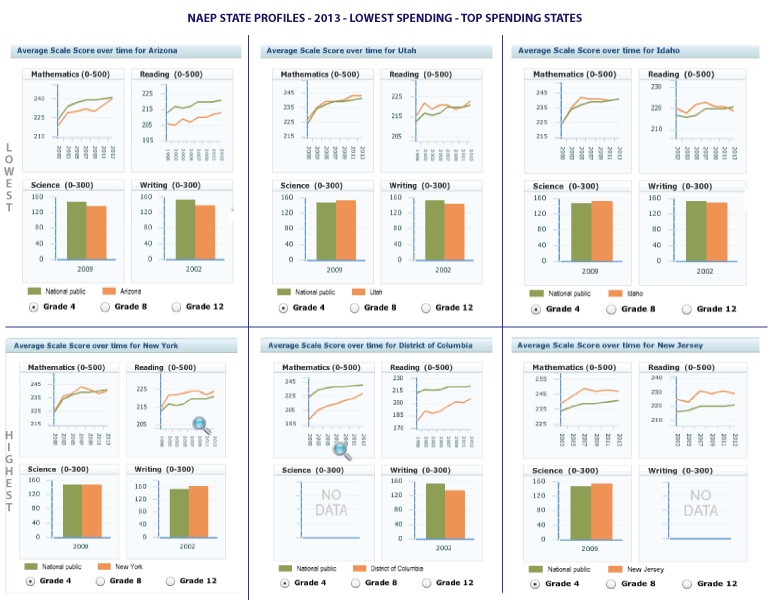
Naturally, states and state-equivalents spending the most per pupil in 2013 were New York ($19,818), Alaska ($18,175), the District of Columbia ($17,953), New Jersey ($17,572) and Connecticut ($16,631). These states have some of the highest costs-of-living in the country.
States spending the least per pupil included Utah ($6,555), Idaho ($6,791), Arizona ($7,208), Oklahoma ($7,672) and Mississippi ($8,130). These states have some of the lowest costs-of-living in the country.
Comparison of lowest and highest per pupil spending vs. NAEP student performance:
Governor Ducey’s Enhanced Funding Education Proposal
Governor Ducey’s Enhanced Funding Education Proposal Background
Related article: Ducey Scrambles to Raise School Funding