
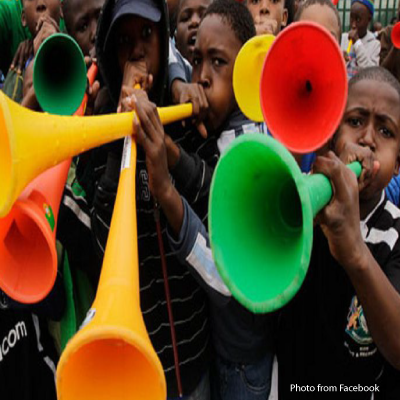
 ASU professor examines vuvuzela craze as World Cup approaches
Every day politicians and educators complain about the lack of funding for Arizona’s educational institutions. However, it appears that the Arizona State University Department of Communications professor, who is studying the popularity or lack thereof or the vuvuzela has more money and time than common sense.
At a time when taxpayers are scrambling to feed their families, professor Jeffrey Kassing is focusing attention on the Brazilian government officials’ ban the percussion instrument known as the caxilora or vuvuvzel; a plastic horn, from stadiums where matches will be held. According to a press release from ASU, “the world will not experience the same type of culture-specific sound as during the 2010 World Cup in South Africa, where the vuvuzela spurred a wide range of reactions.”
Professor Jeffrey Kassing has written a book chapter about the world’s reaction to the vuvuzela. The chapter, “Noisemaker or Cultural Symbol: The Vuvuzela Controversy and Expressions of Football Fandom,” is included in the forthcoming “African Football, Identity Politics and Global Media Narratives: The Legacy of the FIFA 2010 World Cup.” The book will be published July 9 by Palgrave Macmillan.
According o the University’s press release, “Kassing specifically looked at reactions to the vuvuzela in the form of postings by fans on the website of the British newspaper The Guardian, which ran a story shortly after the 2010 World Cup began that indicated tournament organizers were considering a ban on the instrument. Fan reactions flooded the website for three days until the comment board was closed.”
The release notes that negative comments fell into several categories of themes. Some questioned the idea that the vuvuzela is actually a cultural symbol in South Africa. Others said users of the instrument weren’t “real” fans, that the sound would be acceptable if it weren’t used all the time, that the vuvuzela affected communication among players and coaches, and that the sound overpowered the ebb and flow of the game.”
Surprisingly, these themes led Kassing to a specific conclusion: “People felt very strongly that the vuvuzela disrupted the experience of fans and viewers because it conflicted with their expectations of how fandom should be performed,” he said. “In particular, fans felt the vuvuzela interrupted a prescribed soundscape for matches – one characterized by singing, applauding and cheering at very specific moments.”
Kassing concluded that unique sound of the vuvuzela branded the World Cup of 2010 as distinctively South African. According to Kassing, vuvuzela supporters “reminded readers and participants on the message board that there is no one universal version of football fandom and that banning a symbol associated with African football would undermine this truth.”
Kassing is director of ASU’s School of Social and Behavioral Sciences. The school is a component of the New College of Interdisciplinary Arts and Sciences, the core college on ASU’s West campus. He teaches classes for New College’s B.A. and B.S. degrees in communication, as well as the master of arts in communication studies (MACS) degree.
Kassing is paid with taxpayer monies.
Written in part by Matt Crum, ASU PR