
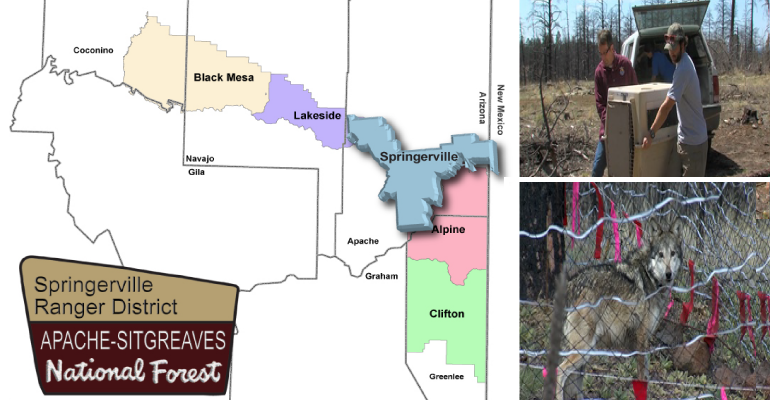
This week, the U.S. Fish and Wildlife Service (Service) and the Arizona Game and Fish Department (AZGFD) released a pair of Mexican wolves into the Apache-Sitgreaves National Forests.
The Mexican Wolf Interagency Field Team (IFT) conducted a “soft release” of wolves – meaning the wolves will be held in an enclosure until the animals chew through the fencing and self-release.
The female is the Rim Pack breeding female that was taken into captivity in January to be paired with a more “genetically-diverse male.” That wolf was whelped at the California Wolf Center in 2008 and eventually moved to the Service’s Sevilleta Wolf Management Facility in New Mexico.
The wolf pair was observed breeding and biologists believe the female is pregnant. The pair was released near the Rim Pack’s old territory in Arizona on the Alpine Ranger District.
“The release of this genetically-diverse pair of Mexican wolves will help us build on our recent success of reaching a population milestone of more than 100 wolves in the American Southwest,” said Mike Rabe, nongame wildlife branch chief for Arizona Game and Fish Department. “The methods used for their release help ensure that these wolves acclimate and behave as wild wolves”
Both wolves underwent an acclimation process at Sevilleta to determine that they are suitable release candidates.
The “soft release” allows the pair to acclimate to their surroundings, and the IFT anticipates the wolves will begin utilizing the area around the release site. The IFT will provide supplemental food while the wolves learn to catch and kill native prey, such as deer and elk, on their own. The supplemental feeding will assist in anchoring the wolves to the area.
The 2014 Mexican wolf population survey results announced in February showed a minimum of 109 in the wild, up from 83 the previous year.
Questions remain as to what the definition of “genetically-diverse means.” Is it a real wolf that has not been in-bred, or is it a hybrid? Also, is a total population of about 100 wolves in the entire Southwest a sustainable population or will additional interference be necessary?
The Arizona Game and Fish Department is working with the Arizona Attorney General’s office to challenge the U.S. Fish and Wildlife Service’s failure to develop an updated Mexican wolf recovery plan that incorporates Mexico, which has historically held 90 percent of the habitat for Mexican wolves.
In his article, Are Mexican wolves in Arizona actually wolf-dog hybrids?, Jonathan Duhamel writes that the “FWS is trying to establish a recovery program for an animal that is not a valid species, contrary to the Endangered Species Act.”
Arizona Rep. Mark Finchem said, “This program was sold as saving an endangered species and “saving the Mexican Grey Wolf. Then the subtle wordsmithing started and moved to the Mexican work. Now we find out this isn’t about the Mexican Grey Wolf but about wolves in general. The narrative that we need to somehow help wolves in the wild is an oxymoron. The moment man interferes with the natural progression of a species it isn’t wild, it is managed. Moving wolves into an area where they have not been and watching them take down cattle calves and other game that is on the edge isn’t about protecting the ecosystem. This is an outrageous breach of the public trust and the use of taxpayer money.”
Related articles:
Grijalva urges expansion of Mexican gray wolf territory, opposition grows
Wolf attacks on humans in North America
Release of “Mexican Grey Wolf” example of U S Govt forest, game mismanagement
Are Mexican wolves in Arizona actually wolf-dog hybrids
Arizona issues notice of intent to sue feds over Mexican wolf recovery plan development