
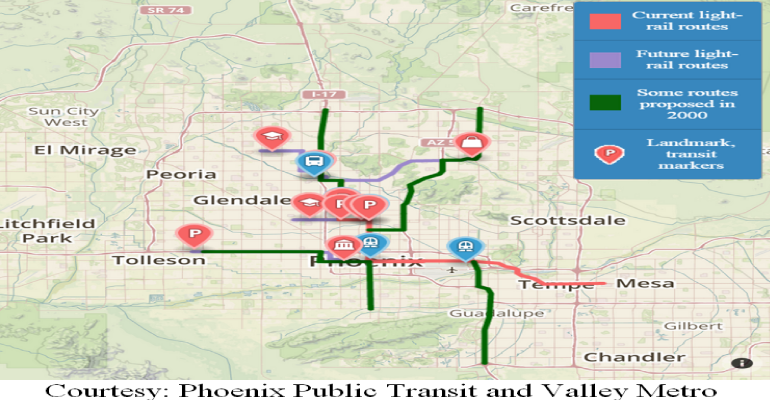
Oregon resident and seasoned transportation analyst Randal O’Toole, of The Cato Institute, has another name for light rail. He asserts that light rail should be called “lie rail.”
He explained, “Because everything they tell you about it is a lie.” To be specific, there are seven big lies according to O’Toole, who presented, “Light Rail: The Truth You Never Hear About,” to a large Phoenix crowd.
O’Toole focuses on the “Seven Myths about Light Rail.” They are:
• Myth 1: Rail transportation is inexpensive Reality: Rail transport is several times more expensive, per passenger mile, than driving or flying.
• Myth 2: We’ve subsidized highways and airports for years; now it is time to subsidize alternatives. Reality: Since at least 1975, subsidies to Amtrak and transit have been many times greater, per passenger mile, than subsidies to highways and air travel.
• Myth 3: High gas prices are leading millions to turn to public transportation. Reality: High prices may reduce driving, but hardly any of that reduction is taken up by public transport.
• Myth 4: Intercity rail and transit improvements can get a lot of people out of their cars. Reality: Despite high gas prices and huge subsidies to transit and intercity rail, Europeans drive almost as much as Americans.
• Myth 5: Rail transport saves energy. Reality: Getting people to drive more fuel-efficient cars will save far more energy than building rail transit.
• Myth 6: Rail transport can reduce greenhouse gas emissions. Reality: Diesel-powered transport emits as much greenhouse gases per passenger mile as driving, and electric power only reduces emissions if the electricity does not come from burning fossil fuels.
• Myth 7: Rail transport helps low-income people. Reality: Financial troubles with rail projects have forced many transit agencies to reduce bus service to low-income neighborhoods.
Over 100 people showed up at a special AFP-Arizona sponsored event at the Conservative Business League office in Phoenix.
O’Toole reviewed the significant points outlined in the paper he produced for The Arizona Free Enterprise Club. His in-depth review of the proposed transit plan included exposing the false claims made about the benefits of light rail in the Phoenix Metro area. The paper can be viewed online by clicking here.
Some of the key findings in the paper include:
• The oft-repeated claim that light rail has generated $7 Billion dollars in economic development is simply untrue. In fact, many of the projects included in this claim have never been built (like the Sycamore Station development) or involve projects that have nothing to do with light rail (such as the $600 million Convention Center Expansion, which was funded largely by state tax dollars).
• The main beneficiaries of the transit plan appear to be contractors and developers who have projects near rail stations. The tax revenue from the plan combined with the generous subsidies offered to select developments ensures that this plan will benefit a few contractors and developers at the expense of others.
• The plan is unbalanced and ignores vehicle street improvements. Despite the fact that only 3% of the population uses transit (less than 1% use light rail), 95% of the funding in the plan goes toward expanded bus and rail service. Only 3% goes toward vehicle street improvements.
• Transit ridership actually fell after the light rail opened. From when light rail opened in 2009 through 2014, any gains in light rail ridership were offset by the loss of more than one bus rider. Ridership is still 1.2 million less per year than it was in 2009.
• The transit plan as proposed will increase traffic congestion, energy usage and greenhouse gas emissions. In fact, the transit plan will use more energy and emit more pollution per passenger mile than the average SUV.