
On Tuesday, September 15, the Arizona Legislature’s Transfer Of Federal Lands Study Committee convened to hear from Idaho County Commissioner Jim Chmelik, as well as environmental and land use experts. At issue is who can best manage Arizona’s public lands.
Chmelik, president of Western Landmark Foundation, was joined by environmental and public land use expert Doyel Shamley, and Sierra Club lobbyist Sandy Bahr addressed the panel during the public comment period.
Chmelik, whose state has been ravaged by wildfires this year, discussed the image of the public lands presented by the Sierra Club and other environmental groups as opposed to the reality of the current state of our public lands. “The environmental community is a $7 billion industry – annual GDP – with over $80 billion in assets and they want you to believe this is the world they are creating and invite you to come visit our wonderful western world ,” said Chmelik referring to a picture of a pristine forest. “But this is the reality of it,” said Chmelik referring to a picture of elk killed in a recent wildfire on overgrown federal lands. “Today, right now, in Idaho County over 300,000 acres are burning.” Chmelik said he “wouldn’t even get into what the economic value of that acreage would have been.”
“We are not managing the forest for our livelihood; we are managing for maximum combustion,” stated Chmelik. “We can do something about this.”
“Through lawsuits using things like the Endangered Species Act, using things like the Equal Access to Justice Act, the environmental communities sue the agencies and no longer should it be called the Federal Land Policy Management Act – it should be called the Fire and Litigation Policy Management Act because they manage their budgets for fire and litigation and that is what they prepare for now,” explained Chmelik. He told the panel “we have to get back to how to manage the lands.
Later Chmelik said, “NEPA: The National Environmental Policy Act should be renamed National Environmentalist Propaganda Act.”
Shamely addressed the economic impact of the current wildfires, fire suppression costs, and lack of management. Shamely reported that the true economic impact is not accounted for by the federal government because it only calculates the cost of its losses in fires. The federal government does not include the state and county resources and structures expended or lost on federal land in a fire and its aftermath. Shamely told how the people in mostly poor northern Arizona lost considerable food supplies as a result of power outages caused by smoke from the Wallow Fire. They bore the cost of mismanagement and that cost was not a factor in the final tally.
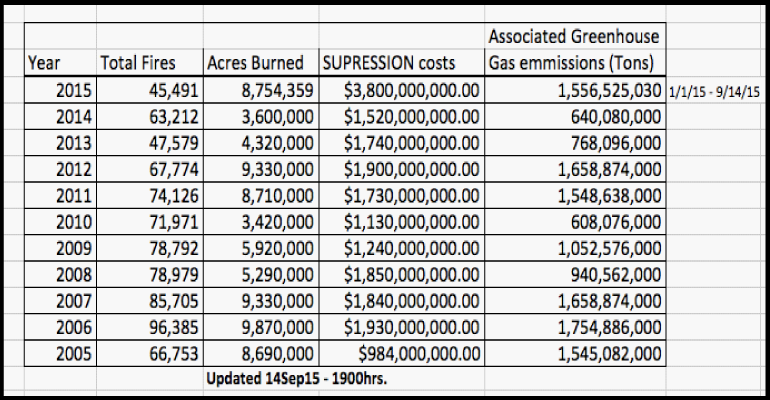
Shamely briefly touched on wildfires and their associated greenhouse gas emissions. Shamely’s research shows for instance that 68,072,000 tons of Greenhouse Gas were emitted by the Wallow Fire alone. In the same year of 2011 all sources of Greenhouse Gas emissions including power plants and natural gas compression and transfer stations, per the EPA’s own data, was only 16,621,243 metric tons of Greenhouse Gas, reports Shamely.
Much of Shamely’s presentation focused on Arizona’s most precious commodity; water. According to Shamely, studies have shown that if active management were to occur, which he and many others argue is best done on the “more manageable state-level landscape,” Arizona’s water demands and needs can be met.
Shamely, who works closely with foresters across the west, advised the panel that managing forests can improve their health as well as increase water yields.
Shamely showed that a treatment area of just 4100 acres, in which overgrowth in a forest is reduced, has shown “a significant water yield increase of 3 inches. Sustained, ongoing treatments in overly dense forests can increase yield by 16%, claims Shamely.
Leaders like Chemlik believe the law in on the side of the states. In 2014, the United States Court of Appeals for the Ninth Circuit found in County of Shoshone, Idaho v. USA, that state law controls (i.e., is “borrowed”) in determining what constitutes sufficient public use.
Chemlik concluded, “We have learned what doesn’t work. We can use common sense to find common ground. Most Americans recognize that. We don’t like to be over there,” said Chemlik signaling to the right, and we don’t like to be way over there,” he said signaling to the left. “We Americans like to be right here,” said Chemlik holding his hands together. “And we like to be guaranteed to have equal access to fairness. They don’t have it in the east, and that is a key think to think about, and they are recognizing it. They’re funding us not to produce on the lands we have. Why? If people in the east think it is okay to dictate to us what we can do in our territory, for lack of a better word, ” Chemlik said referring to the politicians and lobbyists in D.C. “Fine, then give us half of Maryland, give us half of Virginia. I wonder how they would like that?”
The exchange between Bahr and Rep. Darin Mitchell was particularly telling.
Sandy Bahr told the panel that the Sierra Club was opposed to the bill that created the panel. They had hoped to preempt any talk of states controlling the land within their borders. Bahr referred to former Governor Jan Brewer, whose aides opposed local control using the rationale that control would cost the State. Bahr claimed that the State could not afford to control the land.
Rep. Darin Mitchell asked Bahr why states like Michigan was able to control their land, but Arizona cannot. Bahr claimed that under the Enabling Act, “we gave up all claims to the land.”
Bahr told Mitchell, “bottom line is; those public lands do not belong to this state. And that is really where the disagreement is.” Mitchell asked, “And who do they belong to? They belong to the people of the United States, just everybody?” Bahr responded, “They belong to all of us – that’s correct.” Mitchell asked, “Any decision will be made by?” Bahr responded, “They will be made by all of us. Future generations.” “Future generations and their agencies?” asked Mitchell. “Just like with everything else they run. Laws have to be implemented and the Legislative Branch – you all – the Executive Branch enforces those and they relegate to agencies to do that. Just like here. Arizona Game and Fish deal with wildlife policy and I didn’t vote for any of them – I wouldn’t, but so you delegate – that is just how government works.” Mitchell asked, “How did Hawaii, California, or some of these other western states get their land back to some great degree?” Bahr replied, “Well, I consider Arizona very lucky.”
As evidenced by the outrage over the federal government’s move to kill Arizona’s wild horse on BLM land, most Arizonans would disagree with Bahr.
Mitchell stated, “We are facing water shortages, droughts, all sorts of things and our federal lands, which is controlled by the federal government and it is doing such a poor job – I think you would agree – maybe you wouldn’t . Would you agree that they are doing a poor job of managing those lands?”
Bahr responded, “Ah, madam chair, Rep. Mitchell, some of those lands. I would agree with, although I would say that the state doesn’t have a great track records either on managing their lands.”
Mitchell asked Bahr if she would rather stick with the status quo because it is the best we can do? Or how would we rectify the system to make those lands better managed?”
Bahr then accused the federal government of allowing short term profits to take precedence, but claimed that there are “processes where the public can be involved.”
Bahr’s group has often taken the public out of the process by filing lawsuits rather than allow those processes she praised work, according to critics.
Mitchell asked Bahr, “Do you think our forests in some places need to be thinned?” Bahr responded in the affirmative, and said, “but when I say thinned, I don’t mean chopping down the last of the big trees.” Mitchell asked, “Who wants to cut down all the large trees?” Bahr stated that the Jacob/Ryan project, “they are indeed large trees being chopped down.” Mitchell responded, “I didn’t say that there wouldn’t be some large trees, but you were inferring that it would be all large trees.” With that Bahr walked away from the podium.
“I believe we have a solution, and that solution is clear,” stated Mitchell.