
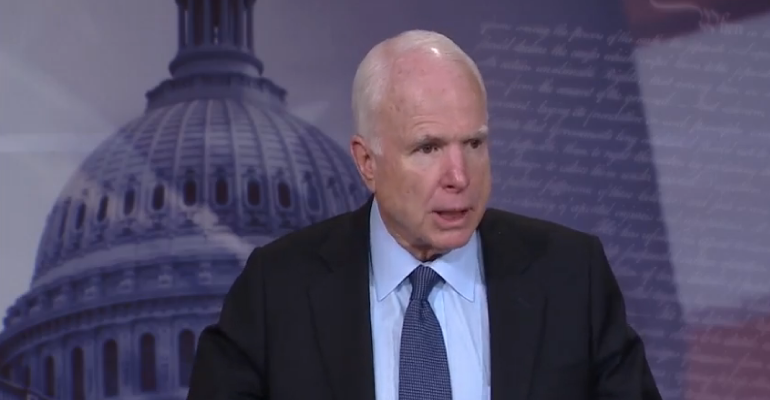
On Wednesday, Senate Armed Forces Committee Chair John McCain (R-AZ) and House Armed Forces Committee Chair Mac Thornberry (R-TX) spoke to reporters following the Senate’s 70-27 vote to pass the fiscal year 2016 Defense Authorization Conference Report. The two addressed President Obama’s threatened veto.
The U.S. Senate voted 70-27 to deliver final passage of the National Defense Authorization Act for Fiscal Year 2016 (NDAA), a defense policy bill that makes significant reforms to the U.S. Department of Defense while reinvesting savings in enhancing the readiness and capabilities of our nation’s military, according to a Statement from McCain.
“Today Congress met its most important constitutional duty to provide for the common defense by passing the National Defense Authorization Act. The overwhelming bipartisan majority of the Congress has spoken: 70 members of the Senate voted for the defense authorization bill. 270 members of the House of the Representatives voted for the defense authorization bill. Now the bill will head to the President’s desk.
“With threats to our national security growing around the world, with our troops still in harm’s way in Afghanistan, Iraq and elsewhere, and with a clear bipartisan consensus in the United States Congress on the vital importance of this legislation, it’s time for our Commander-in-Chief to sign the defense authorization bill and give our men and women in uniform the authorities and the support they need to defend the nation.”
In recent weeks, President Obama has threatened to veto the NDAA because of disagreements about broader spending issues unrelated to defense. Chairman McCain continues to argue that at a time of increasing threats to our nation, it would be misguided, irresponsible, and dangerous for the President to veto this bill and deny American service members the critical authorities and support that the NDAA provides.”
“We have done the research, there have been a total of 4 vetoes in the last 53 years on an NDAA, and every one of them was because of something inside the bill not something that was not outside the bill, which is the thing that the president is complaining about today,” said Thornberry.
Thornberry said that if the president vetoes the bill he loses nothing that he wanted, but if he vetoes the bill he risks losing those measures he valued.
“Think about the headlines today. Russians launch cruise missiles; a new ground offensive is starting in Syria. There is danger wherever you look. This is absolutely one of the worst times I can imagine to veto a bill that supports our troops, that gives the president additional tools to push back against Russian aggression, that gives new tools to push back against ISIS. It really would be misguided and I hope the president will reconsider that,” said Thornberry referring to a veto.
“We have authorized every dollar the president requested,” stated Senator John McCain. “For him to veto what is fundamentally a budget bill – a policy bill, in the name of cost is inappropriate.”
“We have done our job on legislation that has been done in a bipartisan fashion,” stated McCain, who noted that he and Thornberry would not be with Boehner and McConnell in negotiations with the White House. “What we will be doing on every street corner in America, is talking about putting the lives of men and woman, who are serving in the military, in danger over a budgetary fight.”
An effort is under way by those, who support the military men and women, to contact their senators and strongly encourage them “to stand up for our ground troops and prevent the Air Force’s effort to conduct a backdoor divestment of the A-10,” by signing Senator Ayotte’s A-10 letter. In Arizona, members of the public are urged to call McCain at (202) 224-2235 and ask him to support the effort.
HIGHLIGHED PROVISIONS OF THE FY 2016 NATIONAL DEFENSE AUTHORIZATION ACT (NDAA):
The NDAA once again prevents any premature retirement of the A-10, which continues its vital role of protecting American service members and our allies in combat. Despite the Obama Administration’s repeated attempts to retire the A-10 fleet, the NDAA prohibits the Air Force from retiring any A-10 Warthogs and fully funds the flight hours, pilot training, fuel, and maintenance for all A-10s for the upcoming year. The NDAA also requires the Secretary of the Air Force to maintain a minimum of 171 combat-coded A-10 aircraft, many of which are stationed at Davis-Monthan Air Force Base (AFB) in Tucson, and directs the Government Accountability Office to conduct an investigation and review of the A-10’s close-air support mission.
The NDAA prevents the Air Force from following through on its proposal to retire seven EC-130H Compass Call electronic attack fleet airplanes stationed at Davis-Monthan Air Force Base in Tucson. These jamming and surveillance aircraft are critical to protecting our airmen and women from sophisticated electronic attacks in conflicts across the Middle East such as Libya, Iraq and Afghanistan as well as against potential threats in the Pacific and Europe.
The NDAA ensures that Arizona’s small businesses continue to manufacture and innovate new weapons systems and defense technologies that our troops need to defend and protect the nation. The NDAA also removes bureaucratic hurdles and red tape so that non-traditional defense contracting companies in Arizona can benefit from fair and open competition in the defense market. NDAA “bullet points”are:
• Fully funds Army’s request for 64 Apache helicopters to be remanufactured in Mesa;
• Increases the military’s budget to purchase 49 additional Tomahawk missiles, which will be manufactured at Raytheon in Tucson;
• Increases the military’s budget by $140 million to purchase additional anti-tank missiles, which will be manufactured at Raytheon in Tucson;
• Allows the transfer of approximately 125-200 unneeded mobile homes from the Department of Defense to Native American tribes – for which the Navajo and other tribes have long advocated – at no cost to the American taxpayer.
• $16.9 million at Davis-Monthan AFB in Tucson for C-130 storage and cleaning facilities;
• $50.6 million at Marine Corps Air Station Yuma for aircraft maintenance facilities;
• $33 million at Luke AFB for an Air Force Squad Operations Facility;
• $13.2 million at Luke AFB for an aircraft maintenance hangar;
• $5.5 million at Luke AFB for a bomb maintenance facility;
• $5 million at Luke AFB for a fuel offloading facility; and
• $3.8 million at Fort Huachuca for communications facility renovations.
• $45 million for Operation Phalanx, which would increase border security operations by the National Guard along the southern border and could result in an approximately 60 percent increase in aerial surveillance of the region;
• Up to $75 million in additional assistance to Customs and Border Protection operations to secure the southern border, which may include the deployment of personnel, surveillance assets, and intelligence support;
• $50 million to address U.S. Southern Command’s unfunded priorities to increase surveillance and interdiction operations in Central America, a primary transit point for illicit trafficking into the United States; and
• Enables the Secretary of Defense to transfer excess defense articles and equipment to the Department of Homeland Security for border security activities.