
AZGFD, local ranchers, organizations work to protect pronghorn
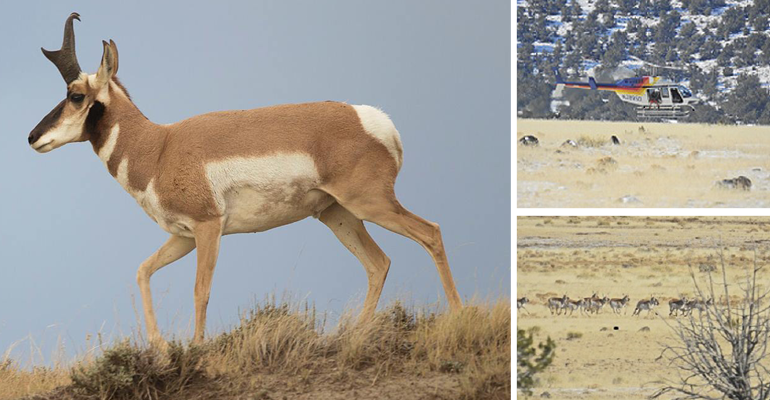
Over the course of two days earlier this month, just off Highway 89 about 30 miles north of Flagstaff near Wupatki National Monument, in between winter storms that hit the area 48 hours apart, the Arizona Game and Fish Department and an army of volunteers was able to capture and collar 23 pronghorn in an ongoing effort to track their movements and improve connectivity between herds.
According to the AZGFD, one of Arizona’s 10 big-game species, pronghorn prefer wide-open spaces where they can use their keen vision and speed to elude danger. The problem is that those wide-open spaces aren’t so wide open anymore. One of the biggest challenges in managing pronghorn is finding ways to minimize the impact of roads, highways, railroad tracks and even fences, which act as boundaries and lead to fragmentation of habitat. Wildlife biologists say they have found genetic differences in populations of pronghorn on either side of highways that left to continue may adversely affect the populations.
Fences, in particular, put the squeeze on pronghorn,reports the AZGFD. While they have the ability to jump over a fence, they almost always prefer to crawl under. For the past several years, the department has worked with the U.S. Forest Service, the Arizona Department of Transportation, the National Park Service, local ranchers, and organizations like the Arizona Antelope Foundation to modify miles of fencing, including the cutting of the bottom strand of barbed wire and replacing it with a smooth wire 18 inches above the ground. The idea is to let the pronghorn out without getting tangled, while keeping livestock in.
“We have a diverse list of stakeholder groups and agencies that are dedicated to keeping this iconic species a part of the northern Arizona landscape,” said Scott Sprague, senior research biologist for Game and Fish. “To be successful on this scale requires the support and participation of a wide variety of players. Without their commitment, the persistence of pronghorn across this landscape could be in real jeopardy.”
According to AZGFD, the recent capture effort north of Flagstaff was particularly successful with the help of the Esri-produced Collector for ArcGIS, which allows biologists and volunteers to better track observation data. With the app installed on their tablets or smartphones, crew members were able to collect, update and share pronghorn sightings while in the field.