
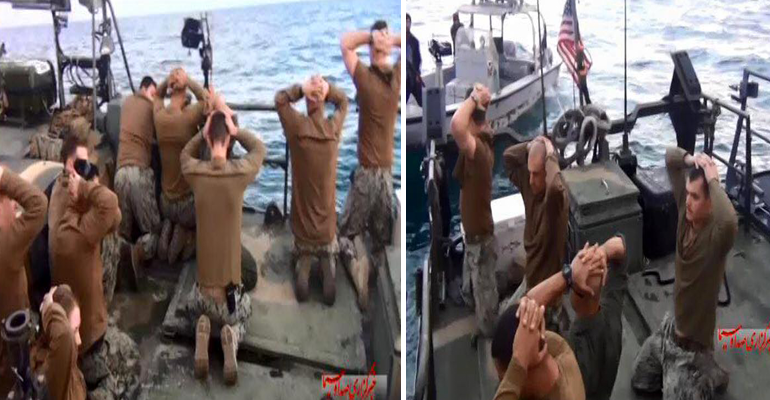
Last week, U.S. Senator John McCain (R-AZ), Chairman of the Senate Armed Services Committee, blasted the Obama administration for its characterization of the Iranian seizure of U.S. ships and sailors.
“This week the Obama Administration desperately clung to the line that the Iranians acted properly and graciously toward the U.S. sailors they detained. White House Press Secretary Josh Earnest said the they were offered ‘the proper courtesy that you would expect.’ Secretary of State John Kerry offered his ‘gratitude to Iranian authorities for their cooperation in swiftly resolving this matter.’ And Vice President Joe Biden described the seizure and detainment as ‘standard nautical practice,’” said McCain in a press release.
“This delusional view of the matter contrasts sharply with reality and the exploitation of these sailors – particularly the photo of U.S. personnel kneeling in their ship with their hands on their heads – is being used for propaganda purposes and to harm U.S. interests around the region,” continued McCain.
“The Iranian seizure of U.S. ships and sailors this week was a clear violation of international law. The Iranians had the right to approach the vessel to verify its nationality. Once determining that the vessels were sovereign immune warships of the United States, the Iranian government had no right to stop, board, or search the vessel. They had no authority to exercise any control of U.S. Navy personnel on the vessel, or to remove them from the vessel. The exploitation of those sailors by photograph, and the video of a forced apology was inappropriate and inconsistent with well-established principles of international law,” concluded McCain.
McCain offered the following “facts”:
“All vessels, including Navy warships, enjoy the right under international law to conduct innocent passage in the territorial seas of another coastal nation.
“International law provides that ships of all nations, including Navy warships, enjoy the right of innocent passage for the purpose of continuous and expeditious traversing of the territorial sea or for proceeding to or from internal waters, like a harbor or river of the coastal state. Innocent passage includes stopping and anchoring incidental to ordinary navigation, or as necessary by distress. Passage is innocent so long as it is not prejudicial to the peace, good order, or security of the coastal nation.
“The only restriction for the naval vessel engaged in innocent passage is that it must not engage in activities that are prejudicial to the peace, good order, or security of the coastal nation. Examples of activities that may be considered prejudicial are included in the Law of the Sea Convention. However, the mere presence of a naval vessel is not listed in the Convention as something that is prejudicial to the coastal nation. The limited information provided on the U.S. Navy vessels’ presence in Iranian waters this week indicates they were there due to navigational error.
“The coastal nation may take affirmative actions in its territorial sea to prevent passage that is not innocent, including, where necessary, the use of force. If a foreign ship enters the territorial sea and engages in non-innocent activities, the appropriate remedy, consistent with customary international law, is first to inform the vessel of the reasons why the coastal nation questions the innocence of the passage, and to provide the vessel a reasonable opportunity to clarify its intentions or to correct its conduct in a reasonably short period of time. If the naval vessel fails to do so, the coastal nation may order the naval vessel to leave its territorial sea immediately. Failure of compliance is subject only to diplomatic complaint.
“The United States claims full rights of sovereign immunity for all naval vessels. All warships enjoy sovereign immunity from interference by the authorities of nations other than the flag nation. Police and port authorities may board the warship only with the permission of the commanding officer. While on board the ship in foreign waters, the crew of a warship are immune from local jurisdiction. A warship cannot be required to consent to an onboard search or inspection. Moreover, warships are immune from arrest and seizure, whether in national or international waters, are exempt from foreign taxes and regulation, and exercise exclusive control over all passengers and crew with regard to acts performed on board.”