
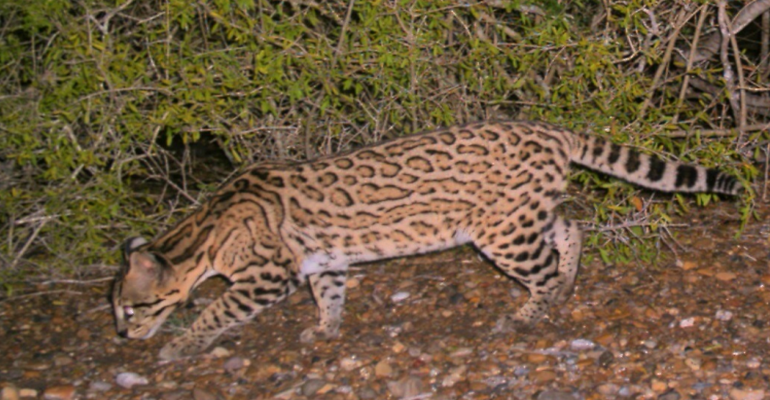
This week, te U.S. Fish and Wildlife Service announced the availability of the final recovery plan, for the endangered ocelot. The plan was developed by the Bi-national Ocelot Recovery Team, which is comprised of experts from both the United States and Mexico, and it updates the original 1990 recovery plan to reflect current species information as well as address the changed social and economic landscapes in Texas, Arizona, and northern Mexico.
In the final recovery plan, the Service notes that a factor affecting the continued existence of ocelots in the U.S. is the increased pressure by the Customs and Border Patrol “on traditionally used points of entry by undocumented immigrants. Thus, immigration shifts into the most inaccessible zones where impacts on the ocelot and other species may be high (Ackerman 1998).”
Rather than complaining that the illegal activity is problematic for the ocelot and as a result must be curbed, some see an opportunity for the federal government to use the ocelot as an excuse to curb enforcement.
Their concerns appear to be valid. In the recovery plan, the Service argues that “after implementing Operation Gatekeeper near San Diego in 1994, apprehension of undocumented immigrants dropped 46% in California whereas apprehensions increased 88% in Arizona and Texas where intense monitoring efforts were not implemented (Ackerman 1998). Through cooperation and consultation with CBP, border security actions will need to be addressed as they relate to ocelot recovery and maintaining connectivity with populations of ocelots in Mexico. Actions on behalf of ocelot survival and recovery will need to consider the cumulative impacts of fencing, lighting, vehicle traffic, and disturbance to habitat patches.”
The ocelot’s range includes Texas, Arizona, Mexico, Central America, and South America. Fewer than 100 ocelots exist in the U.S. and are found primarily in south Texas at Lower Rio Grande Valley National Wildlife Refuge ; Laguna Atascosa National Wildlife Refuge north of Brownsville; and on at least two private ranches several miles to the north. Ocelots have also been seen in Arizona. The ocelot is listed as endangered throughout its range. The ocelot is listed as endangered by the State of Texas and is protected from hunting and live collection in Arizona where it is listed as a species of “special concern.”
According to the recovery plan, “The primary known threats to the ocelot are habitat conversion, fragmentation, and loss associated with agriculture and urbanization, resource extraction, and, to some extent, border security activities. As a result of habitat loss and fragmentation, mortality from collisions with vehicles represents a significant threat to ocelots as they travel across the landscape. In addition, the loss of genetic diversity due to the small size and isolation of the ocelot populations in Texas is negatively impacting the species.”
The major focus of the updated final Recovery Plan for the Ocelot, First Revision, is on two U.S.-Mexico management units: the Texas/Tamaulipas Management Unit (TTMU) and the Arizona/Sonora Management Unit (ASMU).
Recovery plans are guidance and do not obligate the Service or potential partners to undertake the work described in them.
The recovery plan is available at: http://ecos.fws.gov/ecp0/profile/speciesProfile?spcode=A084.