
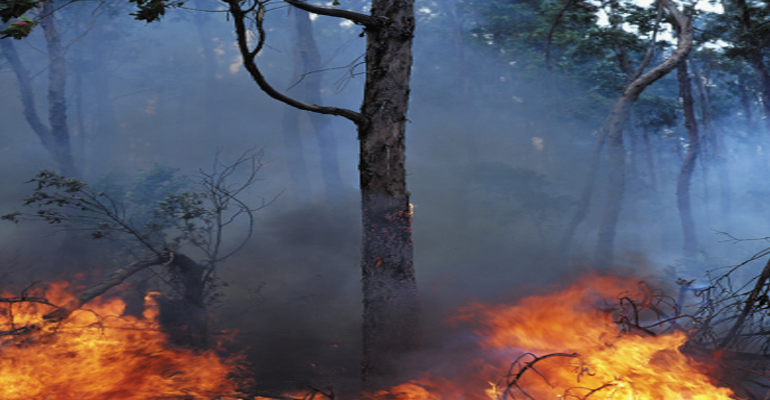
Apache County Natural Resources Coordinator Doyel Shamley told attendees of the Arizona Department of Environmental Quality meeting last month, convened to discuss an alternative plan to the EPA’s clean air requirements, that prescribed burns might be disallowed under the plan.
The meeting in St. Johns, Arizona, allowed Arizona Department of Environmental Quality officials Balaji Vaidyanathan, and Pervinder “PK” Tandon to hear comments from local residents and officials with the Salt River Project Coronado Generating Station regarding the EPA’s clean air requirements.
Shamley, who is a conservationist running for the Apache County Board of Supervisors, stated, “The EPA’s regional haze proposals do not effectively articulate how exceptional events will not be held against the operations of Coronado Generation Station.”
ADEQ is proposing a revision to the Arizona State Regional Haze State Implementation Plan (SIP) and Significant Permit Revision No. 63088 to Air Quality Control Permit No. 52639 for Salt River Project — Coronado Generating Station. The station is located 6 miles northeast of St. Johns.
According to ADEQ: The significant revision to the permit is intended as a component of the SIP revision to assist in satisfying the Arizona Regional Haze Best Available Retrofit Technology (BART) requirements. The SIP and permit revisions will become effective following EPA’s approval and final action rescinding the current Federal Implementation Plan. This permit revision requires SRP to select the option of either installing Selective Catalyst Reduction system on Unit 1 or shut down Unit 1 by Dec. 31, 2029. Until the time SRP decides either of these options, the Permittee will be required to seasonally curtail the operation of Unit 1 by selecting one of four interim operational strategies. The facility is subject to the requirements of the Federal Clean Air Act, Code of Federal Regulations, Arizona Revised Statute 49-426, and the Arizona Administrative Code, Title 18, Chapter 2.
“Apache County would also like to include as part of our comments our understanding of the visibility impairment associated with smoke produced by vegetation fires and emphasize our commitment to and concern for public health and safety, as well as the health of our forests, shrub lands and prairies across the country, which are ultimately linked,” Shamley told officials. Shamley argued that the “impacts directly associated with Coronado Generating Station operations need to be clarified.”
WMICentral.com reported that the “EPA wants SRP to install $110 million in additional scrubbers and other expensive apparatus to reduce emissions from Unit 1 at the coal powered plant or shut down Unit 1 by mid-December 2017.”
“SRP spent more than $500 million in 2008 on Units 1 and 2 to come into compliance with the EPA. Now the company is being asked to spend another $110 million on what CGS officials say is unneeded retrofits they claim the company cannot afford,” reported WMICentral.com.
SRP officials say they have been working with the ADEQ on a plan that CGS officials said would not only meet but exceed the federal mandates outlined in the Clean Power Plan.
In his capacity as Apache County Natural Resource Coordinator, Shamley’s efforts lead Apache County to win government to government legal standing in 2013. In a letter dated that year, Shamely advised Gary Nudd of the EPA: “Apache County, Arizona, feels that the health, safety and welfare of its citizens will be negatively impacted by any over-reaching and severe rulings that stem from Federal guidelines. The mission of the EPA is to guarantee quality of life for the American people, and can best accomplish this through open and honest communication. When a sense of fairness and equal standing of local governments is part of the equation, that mission can be accomplished. Throughout the coming planning periods, Apache County wishes to be a coordinating agency and be fully apprised of all actions, hearings, plans, meetings and outcomes as the process moves forward.
The U.S. Forest Service uses controlled fires or prescribed burns “on public lands in order to improve forest health, and reduce large wildfires. Controlled fire is used only under appropriate conditions and at appropriate sites. The Forest Service has identified areas where controlled fire can be used as a management tool.”
Because of the lack of forest thinning, the west as suffered catastrophic wildfires.
Shamley stressed, “County governments have the additional responsibility of protecting the health, safety and welfare of their citizens. This additional responsibility includes, but is not limited to protecting the societal and economic impacts of federal actions. We recognize this responsibility with the utmost of seriousness and feel we need to address the Air Quality and Regional Haze Implementation Plan actions that effect local citizens in a thorough and serious manner.”