
A respected writer living on the edges of the rural Pima County community of Picture Rocks in the Avra Valley once trashed her neighbors in print. Author Lydia Millet, in the 2008 book of essays State By State, wrote of a local store:
“It is frequented by crowds of emaciated, sun-worn guys in jacked-up trucks, their acid-wash girlfriends and snaggletooth kids with half-open mouths and scarily vacant faces — some, and sometimes all, of the above smelling from afar of nicotine or alcohol. . . . It’s a blight of a place.”
I’ve lived in Picture Rocks for over a dozen years, and I wrote most of the community newsletter for years so I got to see and know a lot of people. I covered locals whose long-time jobs disappeared as the economy changed becoming cleaners and fixers to get by. I have a neighbor who can’t afford to fix his truck and hitch-hikes regularly to the Family Dollar store to buy food for his ailing wife. A few years ago a roof was ripped off by freak winds and good Samaritans came up with a new manufactured home for the resident to live in.
I’ve watched kids at our wonderful school learn to write poems and seen hundreds of involved parents come to the school in their trucks to support their kids’ activities and learning. No “snaggletooth kids with half-open mouths and scarily vacant faces” at Picture Rocks Elementary School; just a group of dedicated teachers with a creative principal doing an amazing job despite declining resources.
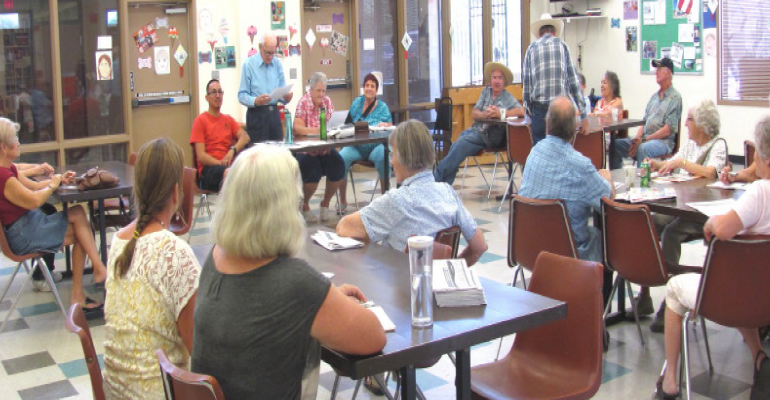
A community improvement group, Citizens for Picture Rocks, cleans up miles of road twice yearly, invites speakers on topics of interest, hosts election forums, and has written successful grants for community improvements. The County’s Picture Rocks Community Center has programs for kids and adults, with activities from raising spadefoot polliwogs to line dancing. Their annual Ladies High Tea, Halloween Trunk o’Treats, Day- before-Thanksgiving dinners, Cookies with Santa, along with lots of pot-lucks and daily lunches, are community gatherings of joy and fun. And every Thursday professional and amateur musicians gather for Hummin’ & Strummin’ and pack the house. The Girl Scouts attract hundreds to their annual Easter Egg Hunt. 4-H Clubs keep rural traditions alive and bring animals and joy to seniors. A Hiking Club explores the desert. Several churches put on festivals. It’s a community.
Picture Rocks began as an “outlaw development” of mostly manufactured homes, some now old and in disrepair, sited on 1-1/4 or more acres. People who couldn’t afford to buy houses in Tucson in the 1970s came over the mountains to settle in. Pioneers established the Rancho del Conejo and Avra Water co-ops. Most roads are dirt and not maintained by the County, a sore point for many people who pay the same tax rates as the upscale developments. In the 1980s the Huns motorcycle gang caused some problems and methamphetamine was a serious problem. The area became known to Townies as “Hells Angel City” and “Tweakerville.” Community organizing changed the culture and eventually won a sheriff’s station and a crime sector where deputies, off-the-record, admit to being bored. People here do like to be left alone. They are not so much anti-social as unsocial, not much for visiting but always ready to help a neighbor in need.
The community has about ten thousand people, with over five thousand voters pretty evenly split between Republicans, Democrats and Independents, with a handful of Libertarians and Greens. They vote as they please and do not let their politics get in the way of friendships and neighborliness. Neighbors of all and no political persuasions work together picking up litter, maintaining a community garden, even “barnraising” with neighbors. Tattoos and beards mix with shorts and sandals; hybrid cars park next to scruffy pickups.
They do, however, get mad.
The powers-that-be seem to consider the Avra Valley a dumping ground for projects not wanted in their more manicured cheek-by-jowl cookie-cutter developments. The Central Arizona Project canal borders Picture Rocks. A giant commercial airport was once planned for the area. SunZia, on President Obama’s “fast track” for approval, wanted to build new roads and power lines through the valley to carry non-existent wind and solar energy from New Mexico to California. The Tohono O’odham Nation nixed that so now the last free river, the San Pedro, is threatened instead.
Then there is Interstate 11, which planners envision as a major trade route to Mexico. Pima County Administrator Chuck Huckelberry came out early with a proposed route through the Avra Valley that includes elevating the highway at Mile Wide and Sandario Roads due to insufficient right-of-way with the Tohono O’odham’s Garcia Strip on one side and the federal Bureau of Reclamation’s Wildlife Mitigation Corridor, created to accommodate the canal, on the other. And, curiously, ADOT’s own numbers show that double-decking just six miles of I-10 would accomplish their goals at one-third the cost, saving taxpayers nearly $2 billion.
While touted as a jobs program, a reading of the I-11 studies shows that planners foresee research and development in Arizona and Nevada with manufacture and assembly in Mexico where wages are expected to be lower than China’s. I-11 is also to accommodate container traffic from the expanding Port of Guaymas, jobs stolen from West Coast American ports. Jobs would also be lost along the present I-10 route and tourism hurt in the Avra Valley’s Saguaro National Park, Kitt Peak, Desert Museum, and more.
Research by the Avra Valley Coalition found that over 1500 acres along the “Huckelberry Highway” route are owned by Mesa millionaire real estate speculator Wil Cardon, whose failed political campaigns were supported by fellow millionaire real estate speculator Don Diamond and his company. Diamond stands to get a free access highway for his planned 3000-acre Swan Southlands development with the Sonoran Corridor, originally shown on County maps as part of I-11. Pima County continues to push forward on that part of I-11 despite rejection by voters as part of the bond package last year. It’s being called “crony capitalism,” a modern variation of last century’s Robber Barons.
Pima County Supervisor Sharon Bronson told Picture Rocks voters at a candidates’ forum that the supervisors, including her, opposed I-11, citing Resolution 2007-343 opposing any bypass of I-10 in the County. That evoked some disbelief since their employee, the County Administrator, is full steam ahead and Bronson herself is quoted supporting him with fervor. Apparently Mr. Huckelberry is exempt from any charges of insubordination by his employers. And foolish us, we thought that we elected supervisors to represent us, not realizing that they would be given their marching orders by a non-elected, but high-paid, bureaucrat.
A number of local residents in the path of the “Huckelberry Highway” have noted that the assessed values on their properties have dropped recently. A site-built house on five acres, for instance, is valued at less than half that of a 22-year-old mobile home on 1-1/4 acres just a mile away. An activist opposing I-11 discovered that his mobile home’s assessed value was double that of his neighbor’s whose trailer was less than half as old sited on the same size property. That translates into support for Independent Assessor candidate Suzanne Droubie.
A fair number of Picture Rocks Democrats are voting for Republican candidates locally this year: Kim DeMarco for District 3 Supervisor; in L.D. 11 Steve Smith for State Senate; Vince Leach and Mark Finchem for State House – because, while they believe I-11 may be a good thing and is coming, they are committed to double-decking I-10 and saving the Avra Valley. Democratic candidates Ralph Atchue and Corin Hammond not showing up at a local candidates’ forum didn’t help their party’s cause. With both John McCain and Ann Kirkpatrick, along with Raúl Grijalva, sponsoring amendments to a transportation bill making I-11 and its Sonoran Corridor eligible for federal funds, there may be a spurt in write-in votes for senator and congressman.
And now, Monsanto has bought 155 acres from Marana Town Councilmember Herb Kai for a giant greenhouse to grow GMO seeds along Twin Peaks Road west of Marana. Pima County is working on “incentives” to cut their property taxes by two-thirds. Monsanto, maker of glyphosate sprayed by aircraft on buffelgrass in the Avra Valley which has sickened residents, was just taken over by Bayer for $66 billion. Even setting aside the international uproar against glyphosate and GMO crops, locals wonder why, with that kind of money, the corporation needs help from local taxpayers?
People in Picture Rocks are not happy with being a dumping ground. Their valley has been a place of peaceful living for over ten thousand years. Many rich archaeological sites document that. Bighorn sheep cross the valley from Ironwood Forest to the Tucson Mountains. Desert tortoises wander the ridges. Harris’s hawks argue with great horned owls over hunting territory. Coyotes have nightly jamborees. The people of Picture Rocks love the desert and its denizens. They don’t call themselves “environmentalists,” but they are in tune with their environment.
Indeed, the environmental movement mostly seems to ignore the threats to the valley. The aforementioned Ms. Millet writes for the Center for Biological Diversity; her spouse is the director and they live in Picture Rocks, but the Center is not heard from on I-11. And they gave Monsanto a “Rubber Dodo” award last year citing the dangers of spraying in California – while glyphosate was being sprayed just a few miles from the director’s home. The Sonoran Institute tried to broker the SunZia power lines through the Avra Valley. The Wilderness Society tried to pull together a coalition of environmental and community groups in support of SunZia. Fortunately, they failed, and have seen the error of their ways. But rural working class people just aren’t on their elitist radar. The Sierra Club, to its credit, opposes an Avra Valley I-11 and has shown itself to be more sensitive to the needs and concerns of real people, including marching against Monsanto.
And that, ultimately, is what the 2016 election is about, and not just in Picture Rocks. Working class people are legitimately angry at a demonstrably corrupt political establishment that, with high-tech multi-millionaires and Wall Street bankers, has not only ignored them but actively threatens their way of life. Many lost their jobs and their homes in the Not-So-Great Recession, and being a greeter at Wal-Mart or a burger flipper at McDonald’s is no substitute for a real job with decent wages. For those who signed up for Obamacare, the costs are escalating and the options shrinking. The Republican’s Trump campaign is fueled by that class anger, as was the Democrats Sanders rebellion.
With the media focusing on the election as shock and entertainment, there is little discussion of actual policies and programs. The Libertarians get some attention but the Green Party – which has put forward a comprehensive program – is ignored. Both Trump and Clinton are actively disliked, and with good reason. It could be asked which is worse: a man who has propositioned and groped women or a woman who defends her womanizing man by attacking the women he’s used his power to take advantage of? Is Trump not releasing his tax returns any different that Clinton refusing to release her speeches to Wall Street? Do not both represent Big Money, crony capitalism? Will senior needs be met by either Trump privatizing some of Social Security or an inadequate cost-of-living raise as a result of Bill Clinton’s revising the Consumer Price Index? Does either one of them have any understanding of what it is like to work for a living, or to be unemployed, outsourced, riffed, as my son just was?
It is being said that a vote for a third party, or a write-in, is a vote for the candidate the sayer opposes. That is not true. A vote for the Green Party’s Jill Stein or the Libertarian’s Gary Johnson is a vote to get away from business-as-usual, a vote to express the direction the voter wants our nation to take. It is a vote for the Greater Good rather than the Lesser Evil. And while local voters may not have much impact on the race for the White House, it is, in fact, local races that will most directly affect them and their families. Locally, an informal sort of “Green Tea Coalition” seems to be in play, as it is elsewhere.
This year it is time to ignore party lines and vote for candidates who most represent what we believe in, or to write in someone we trust where no official candidate fits the bill. Not voting lets them, whichever them you cannot abide, get a free ride. Vote as you please…but please vote.