
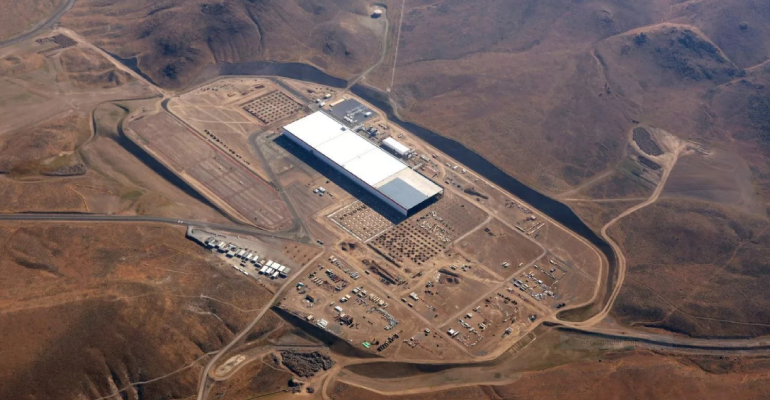
This week, at the Gigafactory, Tesla and Panasonic began mass production of lithium-ion battery cells, which will be used in Tesla’s energy storage products and Model 3. Tesla broke ground on the Gigafactory in June 2014 outside Sparks, Nevada.
Tesla had expressed an interest in building the Gigafactory in southern Arizona, but the area’s political leadership is widely known as business-unfriendly.
Tesla says that bringing cell production to the U.S. allows the company to create thousands of American jobs. In 2017 alone, Tesla and Panasonic will hire several thousand local employees and at peak production, the Gigafactory will directly employ 6,500 people and indirectly create between 20,000 to 30,000 additional jobs in the surrounding regions.
The high performance cylindrical “2170 cell” was jointly designed and engineered by Tesla and Panasonic to offer the best performance at the lowest production cost in an optimal form factor for both electric vehicles and energy products.
Production of 2170 cells for qualification started in December and this week, production began on cells that will be used in Tesla’s Powerwall 2 and Powerpack 2 energy products. Model 3 cell production will follow in Q2 and by 2018, the Gigafactory will produce 35 GWh/year of lithium-ion battery cells, nearly as much as the rest of the entire world’s battery production combined.
The Gigafactory is being built in phases so that Tesla, Panasonic, and other partners can begin manufacturing immediately inside the finished sections and continue to expand thereafter.