
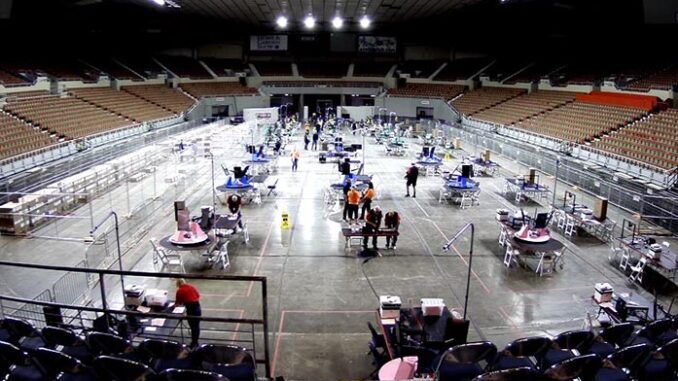
Senate President Karen Fann had hoped to meet with Maricopa County officials on Tuesday to address questions raised by the audit team contracted to review the county’s handling of last November’s general election.
But the county’s refusal to meet -they sent some answers via a letter instead- simply meant that Fann and Sen. Warren Petersen as Chair of the Senate Judiciary Committee had more time to hear from the senate’s top audit officials, all while livestreaming the meeting.
Some of the topics discussed by Senate Audit Liaison Ken Bennett, along with audit general contractor Cyber Ninjas CEO Doug Logan and CyFIR founder Ben Cotton, have been detailed before. Those include Maricopa County’s refusal to turn over computer routers used by its elections department and the county’s insistence that they never had the administrative access codes to any of its ballot tabulation machines.
But Tuesday’s meeting revealed details of various other concerns the auditors have noticed to date, even as the team is only about 25 percent complete with a hand count of the nearly 2.1 million ballots cast by Maricopa County voters in the general election.
One of those concerns involves purported discrepancies between ballot batch transmittal slips and the hard count of those ballots. According to Logan, Maricopa County normally batched its ballots in groups of 200. But even though several batches have a count of 200 handwritten on the transmittal slips, there are actually fewer than 200 ballots in the batch.
Logan added that county officials have said one reason for the difference is that some ballots in a batch may have had to be pulled in order to be hand duplicated for some reason and thus were in a different box.
Duplication occurs when a ballot is torn, stained, or otherwise unreadable by a tabulator machine. A team of elections officials then duplicates that ballot’s votes onto a new ballot that can be tabulated.
However, Logan said there is a section on the transmittal slip to make a “pulled for duplication” type notation but in many instances no such notation was made. Also, audit liaison Bennett told Fann and Petersen that state law requires a unique serial number to be written on both the original ballot and on the duplicated ballot.
Bennett said in many instances the serial number is missing from the original ballot, so auditors have been unable to match up the original to the duplicated ballot.
Auditors are also interested in finding out from Maricopa County officials what type of chain of custody records are available related to photographs released by the county in March which show dozens of boxes of ballots inside a delivery truck.
All 1,681 boxes of ballots were not delivered to the Senate until April 22, and Bennett believes it is important to know what security measures were in place from Nov. 3 until the transfer last month, as it appears they were not being stored in the county treasurer’s vault.
Bennett also informed Fann and Petersen that more than two dozen boxes of ballots were not properly marked on the manifest, including eight boxes that were not listed on the manifest. A revised manifest had to be prepared by Bennett and Maricopa County’s elections director Scott Jarrett.
Much of Bennett’s comments during Tuesday’s meeting dealt with conflicting statements he has received from various county officials about when and how auditors would be able to access the routers subpoenaed by the Senate back in February. Logan and Cotton insist the routers are necessary to fully complete the audit.
At one point, Joseph La Rue of the Maricopa County Attorney’s Office purportedly told Bennett the routers had already been secured for transfer to the audit team, but then later Bennett was told the routers would not be handed over due to the cost. County officials later said access to a virtual image of the routers would be provided instead, but that was overridden earlier this month over claims that such access could put the lives of law enforcement officers across the state at risk.
The purpose of auditing the routers is to ensure elections equipment was not hooked up to the internet, according to Cotton. The process should not provide or allow auditors access to any data file, he said.
Petersen, who is a lawyer, said he was willing to assume that misunderstandings occurred in the prior discussions about turning over the routers. But getting the auditors access to the routers -even if it must be done at the county’s offices- “needs to be a priority,” he said.
The hand count resumes at Veterans Memorial Coliseum on May 24. It is expected to be completed by the end of June.