
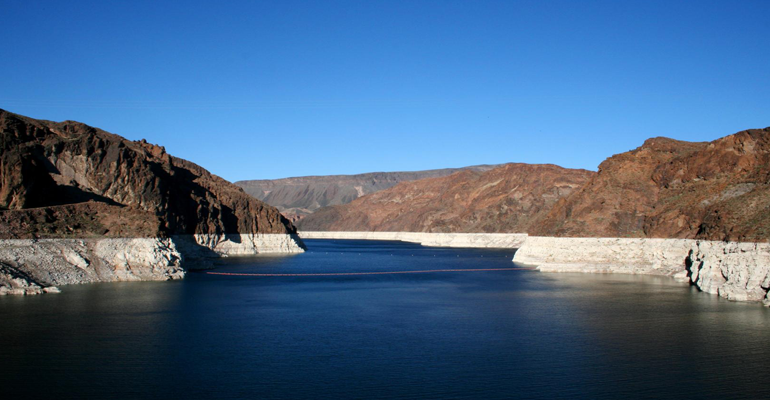
The Interior Department has agreed to preserve Arizona’s water in Lake Mead. The agreement ends the immediate threat of Arizona losing any of that water to another state.
Sen. Jeff Flake, a member of the Senate Energy and Natural Resources Committee, worked to obtain assurances from the Obama administration to not allow another state to take Arizona water stored in Lake Mead as part of a conservation effort during the drought.
On July 8, Flake sent a letter to DOI requesting clarification of the agency’s policy regarding water left in Lake Mead under existing voluntary conservation programs. The Interior Department reads:
Dear Senator Flake,
Thank you for your letter dated July 8, 2016, regarding Section 104 of the Western Water Supply and Planning Enhancement Act (S.2902) and our ongoing management of the Colorado River in the Lower Basin pursuant to applicable Federal law. I am writing to provide information on the Department of the Interior’s (Department) calendar year 2016 operations and decision-making. In particular, you have asked whether the Department would provide clarity on whether and how it may exercise its authority during 2016, pursuant to Article II.B.6 of the Supreme Court’s Decree in Arizona v. California.[1]
Let me begin by reiterating the Department’s concerns with several provisions of S.2902. Nonetheless, as indicated at the hearing on this legislation, we stand ready to work with you to reach consensus language on the legislation.
Regarding section 104 and our ongoing management of the Colorado River in the Lower Basin, the Colorado River Basin is currently experiencing a period of historic drought, and reservoir elevations have declined to levels not seen since the late 1960s. In response to these ongoing drought conditions, the Department has taken a number of actions, and invested millions of dollars, to enhance retention of water in the Colorado River system. Of particular note are two ongoing efforts:
1) Implementation of the Dec. 10, 2014 Memorandum of Understanding Among the United States of America, through the Department, Bureau of Reclamation (Reclamation), Central Arizona Water Conservation District, Metropolitan Water District of Southern California, Southern Nevada Water Authority, Arizona Department of Water Resources, Colorado River Board of California, and Colorado River Commission of Nevada for pilot drought response actions; and
2) Implementation of the July 30, 2014, as amended, Reclamation Agreement with the Central Arizona Water Conservation District, Metropolitan Water District of Southern California, Southern Nevada Water Authority, and Denver Water for a pilot program for funding the creation of Colorado River system water through voluntary water conservation and reductions in use.
The goal of these efforts, in concert with other actions, is to put in place a suite of proactive, voluntary measures that save water for the benefit of all Colorado River water users in order to reduce the risk of reaching critical reservoir levels in Lake Mead and Lake Powell. Among the efforts that these agreements encourage and facilitate, we fully support decisions by water users to voluntarily leave water in system reservoirs in order to benefit system storage and reduce the risk of future reductions. Based on implementation of these agreements and other actions to date, including potential new Intentionally Created Surplus (ICS) programs, Reclamation estimates that by the end of this calendar year (2016), more than 400,000 acre-feet of water will have been retained in Colorado River system reservoirs since 2014. We are committed to working with water users throughout the Colorado River Basin, pursuant to these and other ongoing, and other contemplated, voluntary efforts to retain additional quantities of water in the Colorado River reservoir system storage, including Lake Mead.
Consistent with both the past practice of the Department and my testimony before the U.S. Senate Committee on Energy and Natural Resources in October 2015, we are committed to protect water supplies in Lower Basin reservoirs. Specifically, during Calendar Year 2016, to the extent that there is unused apportionment in one Lower Basin State, the Department will not unilaterally release such apportioned-but-unused water for consumptive use in another lower basin State without the consensus of all three Lower Basin States pursuant to the authority of the Secretary identified by the U.S. Supreme Court in Art. II.B.6 of the Decree entered by the Court in the case of Arizona v. California.[2]
It is our hope that, in addition to encouraging creation (and retention) of system water, clarifying our approach to operations for the remainder of calendar year 2016 will have a corollary benefit: resolving any potential controversy or conflict regarding this issue will alleviate remaining distractions and help facilitate a multi-year Drought Contingency agreement among the Lower Basin States. As I testified, it is through formal agreements that issues such as this can be “locked-in” across multiple years and across executive branch administrations. Agreement – based on consensus among the Colorado River Basin States – has been the context for operations in recent decades, and we remain committed to this goal. Our commitment comes with a commensurate obligation on the States to act in a timely manner to address the growing risks in the basin. Should the States fail to come to consensus, it appears clear that additional actions, including potentially by the Secretary of the Interior, will be required to protect the Basin from the adverse consequences of worsening drought and declining reservoir storage.
We remain committed to working with your office and all stakeholders on these important issues and continue to recognize the need for prompt action to address the effects of ongoing drought in the Colorado River Basin.
Sincerely,
Michael L. Connor
###
[1] Article II.B.6 provides in full:
If, in any one year, water apportioned for consumptive use in a State will not be consumed in that State, whether for the reason that delivery contracts fort he full amount of the State’s apportionment are not in effect or that users cannot apply all of such water to beneficial uses, or for any other reason, nothing in this decree shall be construed as prohibiting the Secretary of the Interior from releasing such apportioned but unused water during such year for consumptive use in the other States. No rights to the recurrent use of such water shall accrue by reason of the use thereof;
Arizona v. California, 547 U. S. 150, 156 (2006). Nothing in this letter addresses the Department’s actions or implementation of 43 C.F.R. Part. 414.
[2] This commitment is consistent with Congressional direction and Reclamation practice. See, e.g., Letter dated May 15, 2015 from Regional Director Terrance Fulp to the Central Arizona Water Conservation District regarding Calendar Year 2014 Unused Apportionment (noting Reclamation’s Lower Colorado Region Policy for Apportioned but Unused Water, dated February 11, 2010). In the May 15, 2015 letter Dr. Fulp stated that “… Reclamation, on behalf of the Secretary, will not reallocate any of Arizona’s unused apportionment [for 2014] and will allow such water to remain in Lake Mead for the benefit of system storage.” See also, Consolidated and Further Continuing Appropriations Act of 2015, Pub. L. No. 113-235, 128 Stat. 2312, Sec. 206 (providing that: “the Secretary of the Interior may fund or participate in pilot projects to increase Colorado River System water in Lake Mead and the initial units of Colorado River Storage Project reservoirs, as authorized by the first section of the Act of April 11, 1956 (43 U.S.C. 620), to address the effects of historic drought conditions.”).