
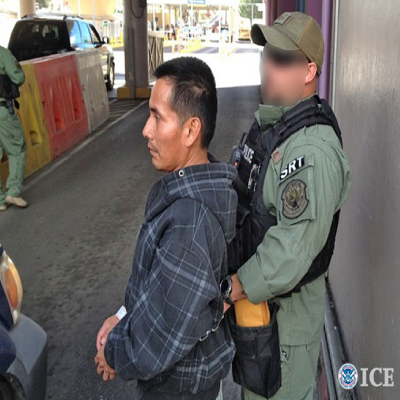
 A Mexican man wanted for murder in his native country was turned over to Mexican law enforcement authorities at the Nogales port of entry Friday, following a joint enforcement effort by Department of Homeland Security (DHS) agencies working under the auspices of the Alliance to Combat Transnational Threats’ (ACTT) Mexican Fugitive Removal Program.
Jose Aguilar-Lucas, 36, was turned over to Mexican federal police by officers with U.S. Immigration and Customs Enforcement’s (ICE) Enforcement and Removal Operations (ERO). Aguilar-Lucas is the subject of a criminal arrest warrant issued in May 2010 by Mexican law enforcement authorities in the Mexican state of Baja California Sur, charging him with homicide.
Ajo Station Border Patrol agents identified the warrant in November 2013, after they arrested Aguilar-Lucas for illegally entering the U.S. and entered his name into the Information, Intelligence and Integration (I-3) program database. Through this new criminal database, agents discovered the active Mexican criminal warrant.
Following his November 2013 arrest by U.S. Border Patrol, Aguilar-Lucas was convicted in December 2013 of criminal illegal entry in U.S. District Court in Tucson and sentenced to 40 days in federal prison. Following his release from prison in January 2014, he was turned over to ERO custody and detained at Florence Detention Center while ERO coordinated his removal with Mexican authorities.
Aguilar-Lucas had been previously convicted of criminal illegal entry in February 2011 and was previously removed from the U.S. four times in 2011 and 2012, following arrests by U.S. Border Patrol.
The I-3 database is a new program created with the Mexican government’s cooperation. Prior to the creation of the program, individuals apprehended for illegally entering the United States were often released at the border; providing they were not wanted for a crime north of the border.
I-3 functions by providing a daily list of Mexican nationals arrested by Border Patrol agents nationwide to the Mexican government. Mexican officials enter those names into their national criminal database to determine if any of the subjects are wanted in Mexico. After confirming the identity through photographs and biographical information, any warrants are forwarded through the I-3 program database in Tucson and a “Wanted Persons” alert is placed in a U.S. criminal database.
Initially, officials in Mexico and Tucson agreed to share these lists of detainees under a bi-national operation, but the operation was so successful it became a permanent program and expanded to include sharing of all types of information, including human trafficking and other intelligence gathered on subjects of interest.