
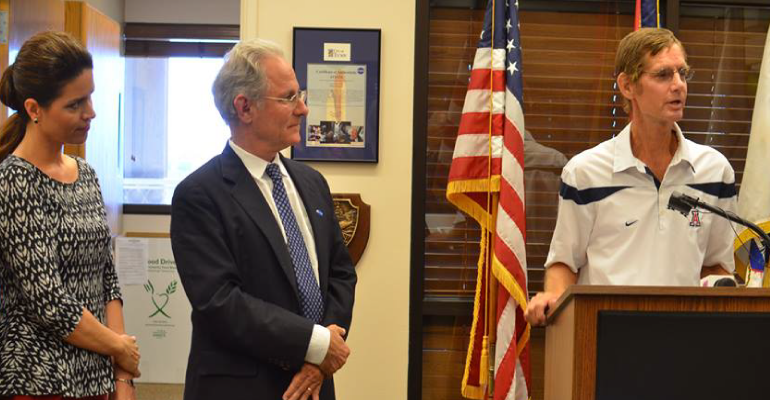
Since the City of Tucson was first “threatened” by the prospect of the USAF’s new F-35, Tucson City Councilman Steve Kozachik and members of the MCRC (Military/Community Relations Committee) have “been working to get DM to focus on making a concerted effort to go after new non-flight missions.” So, it wasn’t surprising to anyone when the findings of a report commissioned by the City of Tucson were spun as fast as the props on a XF-88B.
That spin resulted in a clear message: “Tucson should push for Davis-Monthan Air Force Base to become a Central Operations Base instead of relying on flying missions for its long-term survival.”
The $3000 per page report lacks new information and ignores the most obvious solution for those who hope to protect the base from future BRACs. However, it forwards the agenda of Rothschild, Kozachick and groups like Tucson Forward to ultimately rid the area of pesky pilots and their noisy planes.
Groups like Tucson Forward compelled Kozachik and Tucson Mayor Jonathan Rothschild to be more concerned about the State taking City land when then-Governor Jan Brewer signed an Executive Order in 2014 in an effort to protect Arizona’s military bases, than they were about losing the $1.6 billion economic asset. The anti-flying mission attitude is reflected in the report by Barry Blechman of the Stimson Center.
Blechman’s report reads in part:
BRAC 2005 made no alterations to the Defense Department’s proposed logistical consolidations, even though in response to every proposal moving a combat unit it used almost boilerplate language to condemn the Department of Defense’s analysis. This clean approval applied even to the consolidation of five separate Regional Supply Squadrons, each belonging to a major command, into only two Logistics Support Systems.
Of these enabling capabilities, the greatest plum would be a unit serving the Air Force’s Distributed Common Ground System (DCGS). DCGS is the Air Force’s intelligence analysis and synthesis program, also known as Sentinel. It is run by the 480th Intelligence, Surveillance, and Reconnaissance Wing at Langley AFB. But other than the primary wing headquarters, supporting units are distributed across the country, including at Air National Guard units in Massachusetts, Indiana, and Kansas. Acquiring some elements of this program would achieve multiple goals: further support the 612th Air and Space Operations Center; strengthen the relationship between Davis-Monthan and the Arizona Air National Guard; provide another bridge between Fort Huachuca and Davis-Monthan; and add a valuable power projection enabler to Davis-Monthan.
Other enabling capabilities include Aerial Port units (open airports), Airborne Air Control Squadrons (battle coordinators), RED HORSE squadrons (heavy construction engineers), Combat Camera (public affairs photography), Security Forces units (Air Force police), and many other enablers. No matter how small the unit or the parent unit relationships, any presence on Davis-Monthan will further its claim as a Central Operations Base.
The suggestions are facile to say the least. Support units can be placed virtually anywhere. Justifying the cost of moving one would require proof of increased efficiencies in order to justify the expense. Ignoring Davis Monthan’s unique flying environment in order to chase down non-flying missions that the USAF would likely deem cost prohibitive is not just risky it is unnecessary. Unless of course you are catering to the anti-flying mission crew.
In order to win future missions, advocates for DM must emphasize its uniqueness. Its proximity to the Goldwater Range makes it the ideal facility for joint training exercises something the author ignores.
The author concludes, “…. Davis-Monthan should capitalize on its unique attributes and push the Air Force to recognize the near-inevitable pressures it faces. The Air Force can square the competing pressures of fewer resources yet more missions by streamlining itself for projecting U.S. power overseas…. Davis-Monthan is uniquely positioned to capitalize on such a change. By pushing for it now, Davis-Monthan can get ahead of the threats of BRAC and come out in the end stronger than ever.”
Other than stating the obvious, and ignoring the obvious, the report has little value to the residents of Tucson. It is nothing more than a CYA for City leaders who have been MIA.