
Peaceful protest planned at Saguaro National Park West Monday, August 24, 8:30 a.m.
With Saguaro National Park beginning a second year of helicopter spraying of buffelgrass glyphosate on August 24, the Avra Valley Coalition has called for a peaceful protest at the Red Hills Visitor Center on Kinney Road beginning at 8:30 a.m. Monday morning.
Glyphosate has been banned in a number of countries since the World Health Organization’s International Association for Research on Cancer labeled glyphosate a “probable carcinogen.” Aerial spraying last year sickened nearby families and pets as safeguards did not work as planned. The Park has not reported its effects on wildlife.
The protest will be peaceful and in accord with Park regulations on First Amendment Free Speech rights.
Facts:
Saguaro National Park and Tucson Water have used aerial spraying of glyphosate on Pima County buffelgrass and Coronado National Forest indicates they will also. Saguaro National Park Glyphosate spraying begins August 24. While agreeing that buffelgrass is a problem that wasn’t foreseen when it was deliberately planted here several decades ago for erosion control, residents of the Avra Valley west of Tucson and neighbors of Saguaro National Park have urged these entities not to spray with aircraft because:
1. Glyphosate, the herbicide of choice for killing buffelgrass and the active ingredient in Monsanto’s Roundup® has been declared a “probable carcinogen” by the World Health Organization’s International Association for Research on Cancer (IARC) on March 20, 2015. “Probable” is because the IARC’s 17 scientists from 11 countries don’t want to deliberately cause cancer in human test subjects. Glyphosate definitely causes cancer in lab animals, and in an ongoing Iowa and North Carolina Agricultural Study, has created a higher than expected number of Non-Hodgkin lymphoma and other blood cancers in farmers and their spouses.
2. On March 30, 2015, another study was released showing that glyphosate exposure made humans and other living things resistant to antibiotics, putting them at risk in case of infection. Medical journal reports also link glyphosate to meningitis, leukemia and lower testosterone levels in male children. Glyphosate, and “inert ingredients” like POEA, kills human cells and disrupts endocrine systems.
3. Aerial spraying by Saguaro National Park and Tucson Water in Summer 2014 sickened human and animal neighbors. Several years before Tucson Water cropduster-type spraying was washed onto an adjacent ranch by rain and killed forage grass and mesquite trees. The planned safeguards didn’t work out in practice.
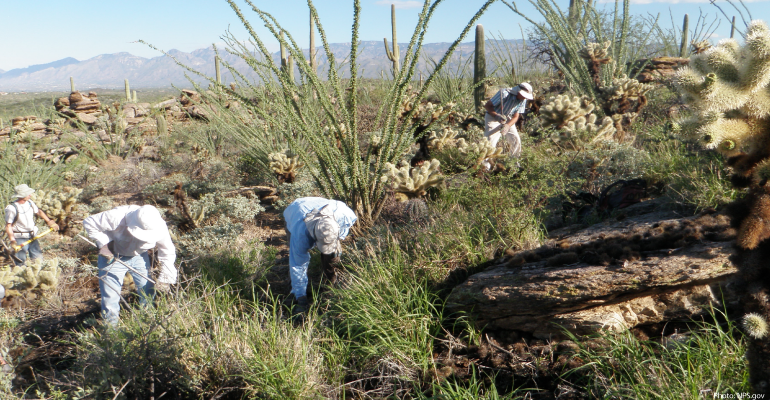
4. Boots-on-the-ground buffelgrass eradication efforts allow people to see, and avoid, desert tortoises, Gila monsters, ground-nesting owls, native plants and wildlife. Aerial spraying may be faster and less labor intensive than digging the bunchgrass out or spraying herbicide from a backpack sprayer, but it cannot discriminate between buffelgrass and endangered or other species.
5. Saguaro National Park, in a presentation to the Southwest Vegetative Management Association in October, 2014, stated that among its “Lessons Learned” was that “Equipment can not be calibration (sic) on the fly (8 ft boom), System needs to purge at end of load and rinsate loads, Accept overlap of spray swaths.” In sum, heavier-than-planned concentrations of the herbicide were laid down. It made people sick. They have not told us what it may have done to wildlife and native plants. (See “Lessons Learned” from Park Restoration Ecologist Dana Backer’s PowerPoint presentation on reverse of this page.)
6. The U.S. Environmental Protection Agency had found glyphosate to be a “possible carcinogen,” in 1985 but reversed itself in 1991 as Monsanto unveiled its “RoundupReady®” genetically modified seeds. Those seeds are altered to resist glyphosate so that the herbicide can be broadly applied to kill all plants other than the desired crop. Glyphosate has been banned in many countries and taken off European shelves by retailers.
7. Glyphosate has resulted in the drastic decline of monarch butterflies and possibly other important pollinators. It kills milkweed, the monarch caterpillar’s food plant of choice, along with other native plants. It is a suspect in the Colony Collapse Disorder that has severely reduced bee populations.
8. Simply spraying poison on buffelgrass won’t stop its spread. The “wonder grass of Texas” is aggressively marketed to Mexico where the Sonoran Government subsidizes its planting as cattle forage. A recently developed Pecos® brand extends its range 150 miles northward. Stopping buffelgrass will take a larger and coordinated effort. Without a comprehensive multi-party agreement the seeds will continue to come on trucks and cars from Texas and Mexico, on tourists and migrants, and on the wind.
It’s all connected !