
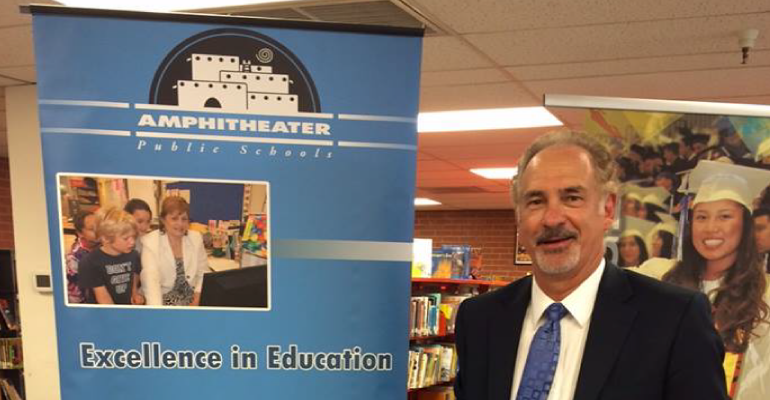
At Tuesday night’s meeting of the Amphitheater Unified School District Governing Board the distrust of the administration, which is rooted in the adoption of questionable curriculum in 2013, was on full display. At issue was Superintendent Patrick Nelson’s request that the Governing Board approve a contract from private vendors that would provide classroom materials and printed workbooks without allowing meaningful vetting by Board members and the public.
Arizona statute A.R.S. 15-721, requires that school boards shall approve: “printed instructional materials or digital content, or both, and related printed or non-printed instructional materials, that are written and published primarily for use in school instruction and that are required by a state educational agency or a local educational agency for use by pupils in the classroom, including materials that require the availability of electronic equipment in order to be used as a learning resource.”
While a portion of classroom materials listed in the Nelson’s request would not normally be subject to the board approval process required by A.R.S. 15-721, there were materials that appeared to be subject to at least the spirit of the law.
Four people who spoke at the public call to the audience. Two of the individuals, Mr. Mick Stewart, who ran for the Amphitheater Governing Board in 2014 and Ms. Ana Henderson, a House candidate for Legislative District 9, spoke against the approval of the materials until the District vetted them as per State Law. Two teachers also spoke, with only one being against the approval of these materials. She indicated that she would have liked to inspect these materials before she was expected to teach them in her classroom.
While Nelson and the District’s associate superintendent/attorney, Todd Jaeger, claimed the materials were exempt, Board member Scott Leska, on behalf of concerned parents and teachers, argued in favor of adhering to State law and transparency. Leska told his fellow Board members that he had received “numerous phone calls on this item. I was caught off guard. When we are given so little information it does not help.” Leska said, “It is frustrating when we don’t get the necessary info. What I am really concerned about is that this is the second time we have gotten something that looks like curriculum.” Leska was referring to the August 11, agenda item, to approve an elementary level Science, Technology, Engineering and Math (STEM) curriculum guidelines with written materials to be used in the classroom.
At that meeting Leska brought up the same issues. Jaeger and Nelson reacted the same way as they did on Tuesday. They claimed then that because the Board was considering guidelines, there was no need to vet it for public review. Leska mentioned that if the Board approved that STEM curriculum at that time, “we as a Board would have been in violation”, referring to Arizona statute, “not the District, but the board.”
Leska then mentioned the elephant in the room; the 2013 adoption of the Carnegie math curriculum that caused a firestorm and planted the roots of distrust. “The Board was bombarded on the Carnegie issue. That shouldn’t have happened, and it should have been vetted by the public and teachers.
In response, Nelson implied that from now on the administration would be more forthcoming. “We recently changed our policy to include the public,” he advised the Board.
Leska noted that the Board and the administration were ignoring the point. “The point,” he said, “is that we are not being completely transparent. What does it hurt to put this before the public? What would it hurt to allow the public to vet this?”
Just as Leska questioned, parents ask the same question as across the state, school administrators engage in the practice of what has become known as curriculum dumping; similar in nature to document dumps. Whether in an effort to avoid scrutiny or out of sheer laziness, administrators put volumes of materials, requiring formal adoption, before school boards tucked away in consent agendas. Those boards are then advised that time is of the essence, and the materials are too vital to take the time for proper vetting by the public. In the alternative, boards are told that they can trust the administration and approval is more a clerical function than anything else.
Due to a deep desire to support education in every facet, and Arizona School Board Association training that they must be nothing more than rubber stamps, few school board members are willing to demand adherence to Arizona statute. The failure of statute to have any real consequences for those who defy it, also contributes to a very laisse faire attitude toward their duties as prescribed by law.
However, it was Amphitheater Board member Kent Paul Barrabee, who openly admitted what is far too often the case our schools’ administrations and governing board. Barrabee, a Harvard educated former educator and current representative of the Arizona School Boards Association to the Metropolitan Education Commission, said in response to Leska’s concerns, “We want to lessen the burden on ourselves and administrators.” Barrabee claimed that he and the District’s administration were over-worked and that the Board should trust them. He implied that adherence to Arizona law is too onerous is unnecessary.
Perhaps it is the attitude that the job is too big that was behind the District’s decision to ignore the law, but for Amphitheater parents and stakeholders, transparency is not too much to ask for.