
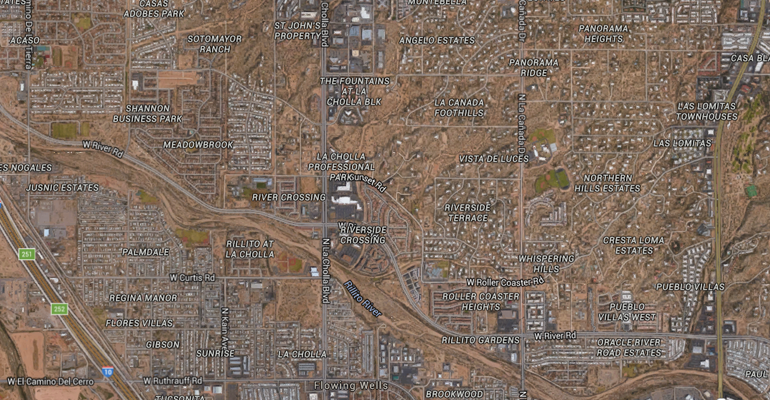
This month, Select Development filed suit against Pima County alleging that the company “encountered multiple problems caused by the County,” on the road construction project referred to as the La Canada Road, River Road to Ina Road Improvement Project.
Pima County’s failure to perform in a transparent and timely manner is legendary and according to the lawsuit, those habits haunted the road project as well. In its lawsuit, the company details the many obstacles it faced due to the County’s failure including delays “in responding to Requests for Information, significant unidentified site conditions encountered during performance of the work, third party utility conflicts, and design errors and omissions in the Project plans and specifications.”
In a memo regarding the case, Pima County administrator Chuck Huckelberry claims that the County will “vigorously defend” itself.
Select completed the project on July 23, 2015 after having worked added an additional 114 days due to the County’s failures.
“Select submitted its final application for payment to the County for the construction phase on or about June 30, 2015, and Select requested release of retention on July 30, 2015,” reads the lawsuit. “Select has submitted all documents required by the Contract for final payment, except for those lien releases and waivers from subcontractors with whom Select has disputes. For those subcontractors, Select’s surety, Western Surety Company, has provided the County with written assurances that it will indemnify the County for any claims brought by such subcontractors.”

The County is refusing to make final the payment. According to Select, the County still owes $75,975.52 for the project, and “retention in the amount of $894,225.59.”
According to Select, “The County has recognized its obligation to consider and fairly address Select’s claim under the applicable provisions of the Standard Specifications. Indeed, the County requested additional information and stated that “delay to the Project that can be clearly demonstrated to have been caused by the County will support the argument for an extension of contract time and additional compensation.” Select offers as evidence a letter dated July 24, 2014 letter from Pima’s Priscilla Cornelio to one of Select’s owners, Brandon Neal.
The lawsuit alleges in part:
Throughout the Project, the County took longer than permitted to respond to Select’s RFIs.
The County’s delay in responding to Select’s RFIs was primarily caused by the County’s coordination difficulties, plan revisions, value engineering, and delayed third party utility approvals. Select was not responsible for any of these issues.
The County’s delay in responding to Select’s RFIs was primarily caused by the County’s coordination difficulties, plan revisions, value engineering, and delayed third party utility approvals. Select was not responsible for any of these issues.
The following chart illustrates some of the County’s delayed responses to Select’s RFIs:
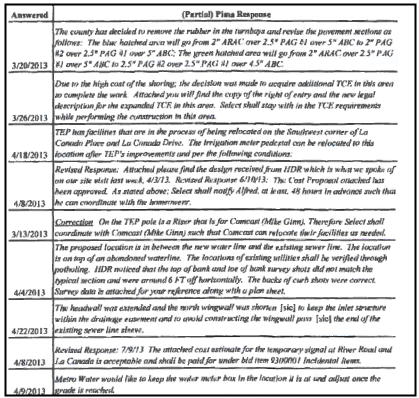 As reflected in the chart, the County took extraordinary amounts of time to respond to many of Select’s RFIs:
· Nine months to respond to RFI 20;
· Six months to respond to RFI 61;
· Two months to respond to RFI 118;
· Two months for the initial response to RFI 120; an additional two before the County provided its revised response; and
· More than one month to respond to many other RFIs
Select bid the project to limit the number of mobilizations to ensure efficient production on the Project. The County’s multiple change orders/directives to Select and the County’s delayed responses to RFIs prevented Select from effectively mobilizing and scheduling the Project and proceeding efficiently with the Work. These obstacles and problems impacted nearly every item of work on the Project.
The initial sequencing as planned by Select would have allowed equipment to work continuously from north to south as reflected in the accepted Project schedule. Select incurred additional costs for mobilization as the Project was constructed out of sequence and additional equipment had to be mobilized in order to work in several areas at the same time.
Because of the County’s changes and continued delays responding to RFIs, the initial phasing was abandoned.
Because of the County’s delays, Select was forced to handle material multiple times and stockpile material in areas that disrupted the schedule.
Because of the County’s delays, Select was required to rent additional equipment to work in many different locations at the same time as the original phasing of the project was abandoned.
The County’s problems with third party utility conflicts, design errors and omissions in the Project plans and specifications, and delayed responses to RFIs impacted Select’s ability to install the concrete curbing efficiently.
The concrete curb was bid to be installed using a machine that would install long runs of curbing at one time to complete that scope of work efficiently. The plan was to follow the road construction phasing to complete the work. The Project was not built using the initial phasing because the Joint Utility Trench (JUT) was not completed in accordance with the Project Schedule because of the County’s changes and continued delays responding to RFIs, the initial phasing was abandoned.
These delays caused the concrete curbing work to be completed in small segments to accommodate traffic. The delays also forced Select to complete many segments of the curbing using hand forms because those areas could not be tied in on schedule. This was because drainage structures could not be completed as a result of the County’s delayed responses to RFI’s.
The County also delayed Select’s work as a result of its poor scheduling of third party utility work.
Two months after Select submitted RFI 118, the County responded that “[Tucson Electric Power] has facilities that are in the process of being relocated on the Southwest comer of La Canada Place and La Canada Drive. The irrigation meter pedestal can be relocated to this location after (Tucson Electric Power’s) improvements.”
During performance of its work on the Project, Select encountered many County delays and third party utility conflicts, which significantly interfered with Select’s planned sequence of work.
The removals, roadway grading and underground utility and drainage work were substantially delayed by unknown site conditions. For example, during construction, PCDOT Materials Laboratory discovered silty material that was unsuitable for roadway construction. Nearly four months after Select submitted an RFI on this issue, the County responded, informing Select that the silty “material shall be removed and replaced with “approved” native on-site material.”
Select also encountered multiple design errors and omissions in the Project plans and specifications.
Because of the errors, the County made design changes in the middle of the Project, which changes disrupted Select’s work.
For example, the County’s design originally called for installation of Asphalt-Rubber Asphalt Concrete (“ARAC”) for the entire roadway.
Relying on the original design, Select bid the Project so that the ARAC would be installed using bottom dump trucks and an elevating pick up machine.
During the Project, Pima County changed the design of the roadway from ARAC to Asphalt No. 2 at certain specified intersections and side streets. So, instead of being able to install ARAC from one end to the other without picking up the paver, Select was now required to stop and start the paving work at every intersection.
This design change significantly changed the installation process from laying material in front of the machine to dumping material directly into the machine. This process is significantly less efficient and more time consuming. This, along with further design changes and direction by Pima County, required changes to Select’s means and methods, which caused significant delays.
The County did not provide an adequate time extension for the additional time to install the asphalt.
The parties agreed in Change Order 7 that Select’s overhead costs totaled $3,502.34 per day.
The 114 work-day delay caused by the County that was not previously accounted for, plus the 18-day misclassification of zero work days totals 132 days of delay for which Select is entitled to be paid its daily overhead rate. Select has been damaged in the amount of $462,308.90 for extended overhead costs as a result of the County’s failure and refusal to recognize the 132 days for which Select is entitled to additional overhead.
Select incurred significant additional costs because of the County’s disruptions and delays of Select’s work on the Project. Select’s additional costs attributable to the County’s delays and disruptions total $5,123,953.37.