
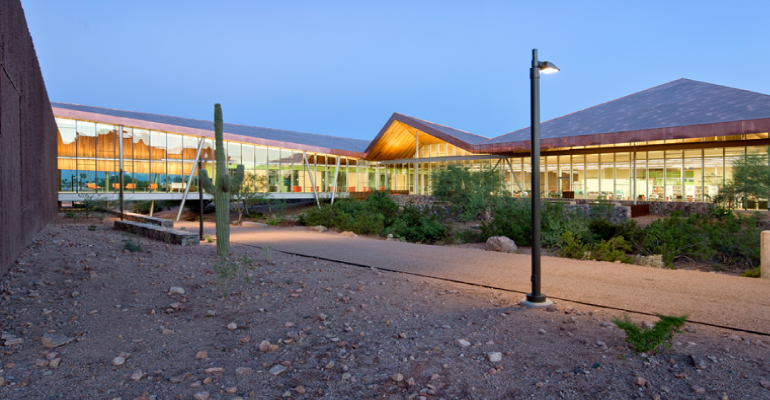
In 1961, the State Legislature passed a bill to allow qualifying counties to form junior college districts. In January 1962, Pinal County Superintendent of Schools Mary C. O’Brien’s appointed Junior College District Governing Board held their first meeting.
The first Campus at Signal Peak was completed with bond funding in 1969. Pinal County Junior College had student enrollment of approximately 1,000 students. In 1974, the College of Technology, now called Aravaipa Campus, was purchased with bond funding in 1974. The Superstition Mountain campus began with the purchase of a small strip mall in 1982.
Today, Central Arizona College (CAC) facilities exist at Signal Peak, Aravaipa, Superstition Mountain (Apache Junction), Maricopa, San Tan and Casa Grande. But as you will realize, the rapid expansion of the college was not supported by a rapid increase in enrollment.
In 2004, a twenty year-long range plan was created to further expand the Junior College throughout Pinal County. In 2005, a huge $491.8 million dollar bond (just under one half billion dollars!) to cover a four-phase expansion was defeated by the voters. However, the CAC powers refused to be denied. They floated a smaller $98.975 million dollar bond (which was the amount of the first phase anyway, based on the CAC feasibility study), which the voters approved.
In 2007, CAC purchased the palm Center outlet Mall in Casa Grande. There, CAC established the Corporate Center and a GED Center. The Corporate Center is an interactive TV facility without local instructors. Cliff Terry, of Citizens Awareness Forum, that investigated CAC, interviewed students who claimed the labs are used by no more than three students and lack supervision and training.
The great recession of 2008 hit everyone adversely . . . everyone except CAC. The management of CAC decided to continue its expansion and servicing of the $98.5 million first phase bond issue. The second phase expansion bond issue passed. CAC is now looking at passing the phase three expansion of $135 million even though its projected population figure is 27% below the projection supporting the bond issue. From FY2007/2008 to FY 2014/2015, the CAC property tax rate (primary and secondary) increased from $1.41 per $100 assessed evaluation to $2.65, or 87% during the period.
Normally, when student population decreases, expenses decrease. However, this is not true of CAC. From FY 2010/2011 to FY 2014/2015, annual district average Full Time Equivalent Enrollment (FTSE) decreased from 3,796 to 3.188, or 16.0%. Meanwhile, the CAC property tax rate increased from $1.84 to $2.65, or 44.0%. During this same period, tuition per credit hour has increased from $65 per credit hour to $80 per credit hour, or a 23% increase.
Table 1
Central Arizona College Key Performance Indicators
| FY Ending | Annual FTSE | %+(-) | CAC Combined Tax Rate | %+(-) |
| 2008 | 3,812 | $1.46 | ||
| 2009 | 4,407 | 15.60% | $1.46 | 8.20% |
| 2010 | 5,036 | 14.30% | $1.59 | 8.90% |
| 2011 | 5,129 | 1.80% | $1.84 | 16.30% |
| 2012 | 5,246 | 2.30% | $1.88 | 1.60% |
| 2013 | 4,893 | -6.70% | $2.25 | 19.70% |
| 2014 | 4,426 | -9.50% | $2.26 | 0.40% |
| 2015 | 4,130 | -6.70% | $2.64 | 16.80% |
As the Arizona Tax Research Association (ATRA) pointed out, this was a $9 million dollar rate grab because CAC State money was cut by $1 million dollars under the constitutional 1% cap reforms. The CAC action goes to the greed and unethical behavior of the CAC Board and executive management.In May 2015, the CAC Board decided to increase the property tax rate by 48%. The Board, under pressure from voters, later reduced the tax increase to 23%. This is the same strategy the Board used in 2013, when it proposed a 35% property tax rate increase and then, under voter pressure, reduced the increase to only 19.7%.
A September 2015 Special Report on Community College District Finance by the Arizona Tax Research Association showed the FY 2016 average primary property tax levy per FTSE for all community colleges to be $5,555. CAC had the second highest levy per FTSE at $9,014, a 30% increase.
Maricopa Community College came in at $5,398 and Pima Community College came in a $4,535. When the State’s two most populated counties can operate at 60% and 50%, respectively, of the CAC levy, the fiscal responsibility of the CAC Board and executive management must be questioned, and even investigated.
An additional indicator of malfeasance by the CAC Board and executive management is the CAC budget. Each year, CAC projects the number of FTSE it will have. CAC uses this projection for budgeting.
Table 2
Central Arizona College Projected v. Actual FTSE
| FY End | Projected FTSE | Actual FTSE | %+(-) |
| 2011 | 5,500 | 5,129 | 93% |
| 2012 | 5,500 | 5,246 | 95% |
| 2013 | 5,770 | 4,893 | 85% |
| 2014 | 5,510 | 4,425 | 80% |
| 2015 | 5,250 | 4,130 | 79% |
CAC budgets for over 5,000 students but it has barely over 4,000 students FY ending 2015. CAC, in this last fiscal year, was off target by 21%
At a glance, the take home message is CAC enrollment is falling from 2011 to 2015: Fall and Spring semester FTSE enrollment is down 17%. From 2011 to 2015, average full time student enrollment has fallen 20.8%; average part-time enrollment has fallen 28.2%.
Yet, CAC budgets continue to grow and property taxes are increased without voter approval. The Citizens Awareness Forum has determined that executive management may have profited from the purchase of inflated land for one of the campuses. The Board of CAC, Citizen Awareness Forum found, approved the purchase.
The question every taxpayer in Pinal County should be asking the CAC Board is quite simple: is there no oversight? Does CAC need independent oversight? The blatant, self-aggrandizing legacy building fiscal irresponsibility by the CAC Board must stop.