
Recently I heard the news that a federal court upheld a City of Phoenix ordinance banning retail sales of dogs and cats unless they sell only rescue dogs. It is meant to put an end to puppy mills and prevent the pet population from skyrocketing to near uncontrollable levels.
The law makes sense, and because laws like this have been enacted in dozens of cities across the country, I decided to see just what was available at a rescue center like the Pima County Animal Control Center.
I had to make two visits. Not because I found a new best friend, but because of the state in which I found some people’s next best friend.
On both visits, the initial impression was that the animals were living in conditions that were healthy enough to allow someone to bring them into a new home without much concern.
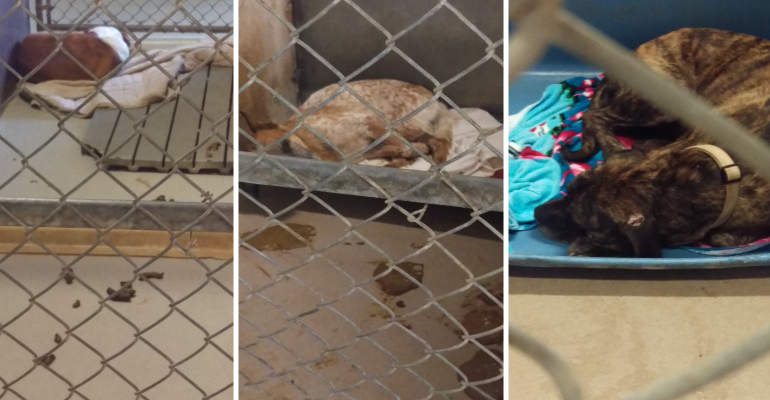
In the area that held the small puppies, I saw a few cages with fresh feces in them, but assumed that the mess had been made within the last five minutes and the staff would be soon preparing to clean them.
Many of the dogs in that area were small – yet not small enough – to fit in the puppy kennels. Some dachshunds, others Chihuahua, and more than a few pit bulls, all living in acceptable conditions.
Deciding that none of these dogs were exactly what I was looking for, I decided to look into the larger room right next door. Immediately I had to hold my hand to my nose.
The overwhelming smell of feces was unbearable. Looking at the rows of dogs, one could see that at least every other kennel had fecal matter piled in it – and none as fresh as what I saw in the puppy kennels. Some of these piles were on the dog’s bedding, which in some cases was nothing more than a blanket over a plastic plank-like grate. Other dogs had no bedding so that the filth seeped through onto the concrete beneath them.
Leaking faucets and pipes were mended together with tape, and one stretch of pipe had a large bucket underneath it. It was clear that the bucket had been left there for a while, as it was nearly filled to the brim, and it was still collecting water.
On my second trip, hoses were leaking into buckets, but on a different row. I couldn’t tell if the duct tape was new, but on my second trip, it looked as if it was losing its grip.
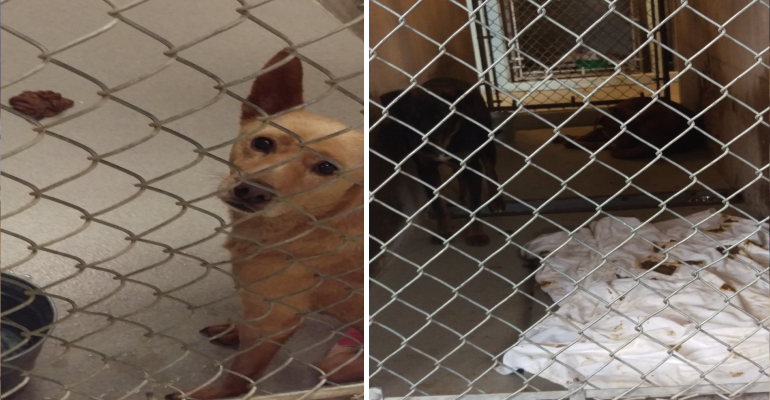
As I made my way through the rows of dogs, I spotted two sections fenced off to the patrons. Wondering why the rows were fenced off, I was lucky enough to overhear the staff explain to another patron that those rows were for “fighting dogs” and others collected in the field that were too aggressive to be handled. Yet, in that area, they had two, sometimes three dogs, to a single kennel. The kennels were probably no bigger than a bath tub – perhaps maybe a foot or two longer.
Still further on, I found more dogs with puddles of feces, fresh and rank sitting directly in front of some of their beds. No longer were they healthy looking clumps; they were more like the waste of sick animals. In some cases there were two or three miniature lakes in the cages. In one kennel, I found a dog that seemed uninterested in me as I read the piece of paper that hung from a safety clip explaining how she came to be at the center. While sad, at the very least her paperwork was not smeared with fecal matter as another dog’s had been.
That dog was a pit bull and she was apparently picked up by officers in the field. When she had arrived in the center she had wounds on her, suggesting perhaps she was a fighting dog that had been taken from her masters after a bust. The wounds were so old she apparently had maggots in them. She was treated and eventually the cuts were cleaned, ridding her of the parasites. Later she developed kennel cough and that was later treated.
She was a staff favorite according to the advertisement, but one word grabbed my focus as I read her medical report and basic information that was clipped on the cage. Aggressive. Written in red ink. And this dog was available to be walked and adopted to any who wanted her. The words were written in small print, on the bottom of the page – definitely not noticeable next to the bright blue advertisement right next to her information.
Seeing that the dog was at one point sick, I decided to see where they treated the sick animals. Replacing the hand over my face with the hem of my shirt to mask as much of the horrid smell as possible, I made my way forward. The smell of feces again hung in the air like spoiled fish at a market. The odor was so thick; the air almost had a taste to it. A disgusting taste.
 The sick kennels had fresh puddles and dried ones. Down the row, were puppies that were clamoring for me as I approached; walking over – and in – their own waste, they sat as I tried to regroup from the odor that grew stronger when I knelt down. I watched as people were bringing their potential new best friends out into small walled off areas that were right next to these pups. These sick dogs. These sick creatures that were forced to sit and stand in their own sickness, which also wafted through the air and enveloped the potential adoptees.
During my first visit, I stayed for an hour. Not one of the dirty cages I saw when I arrived were cleaned by the time I had left. On the second visit, I saw that some of the cages were now clean, but the remnants still stained the ground, and other cages were filled with feces. The smell remained the same; pungent…. putrid even.
If Pima County is committed to a no kill shelter then it must be a humane shelter. The sights I saw were not acceptable, and the conditions were anything but humane.
Note: If you are looking for a new best friend, these animals need a home. In May of this year, Maricopa County Animal Care & Control (MCACC) sent 75 dogs from their West Valley Animal Care Center to the Humane Society of Missouri (HSMO) where the residents are eager and able to adopt them. There are solutions if anyone cares to look for them.
Related article:
Pima County Prop 415 consultants, strategists win big
Pima Feuds, Maricopa Moves Pets
Pima County pet pound bonds sold